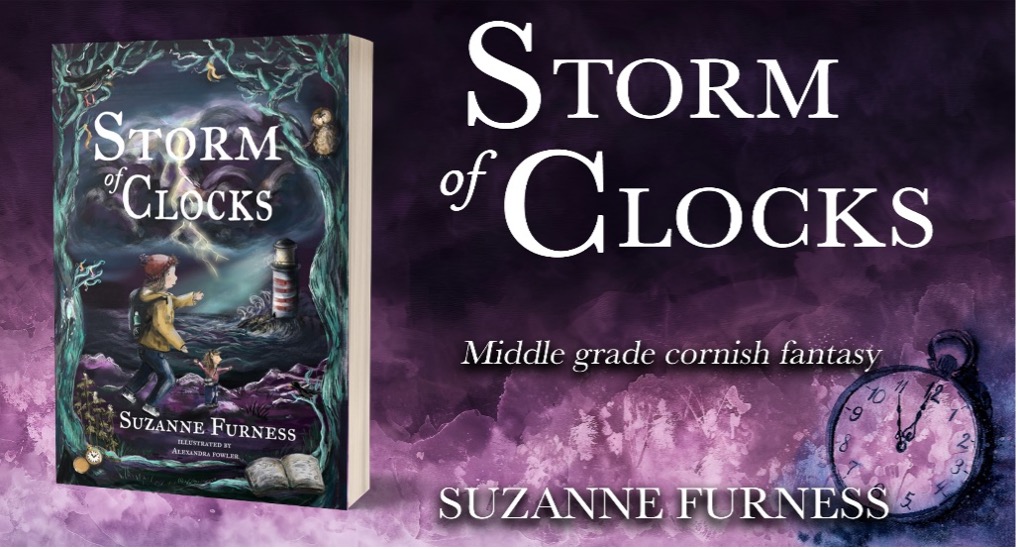
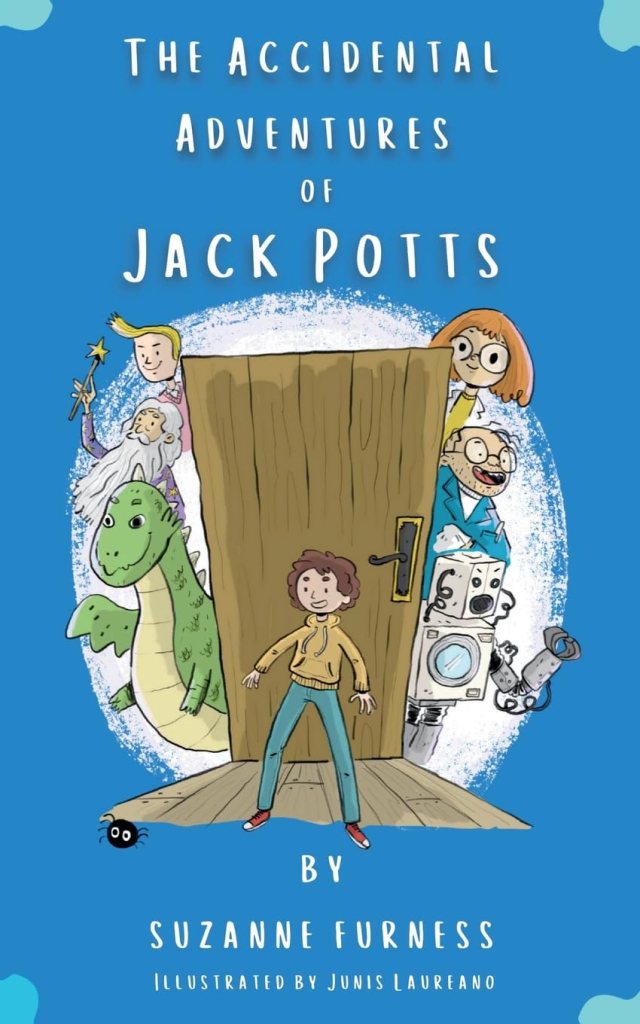
It’s time to meet Fantasy author, Mark Piggott. I’m excited to talk to Mark about his latest book which is currently on preorder.
Helen: Welcome, Mark. Thank you for joining me today. I am so excited to chat about your new book.
Mark: My latest release is a dark fantasy called A MAKER OF MAGIC. A world divided by light and darkness. In the north, Engressia is a lush, fertile land filled with life. In the south, the Ebon Abyss is a dead zone filled with unimaginable horrors shrouded in total darkness. The only separation between the two is a stretch of land known as the Twilight Crossing. Here, a battle between the living and the dead has been going on for centuries. As forces within Engressia conspire with the Blood Countess to bring down the kingdom from within, a prophecy with the means to end the war comes to pass. From within the heart of Engressia, a destined duo are born, united to lead the fight against the undead horde: the Blademancer and the Enchanter.
Helen: This is quite a different style to your Avalon covers, how did you come up with the cover design?
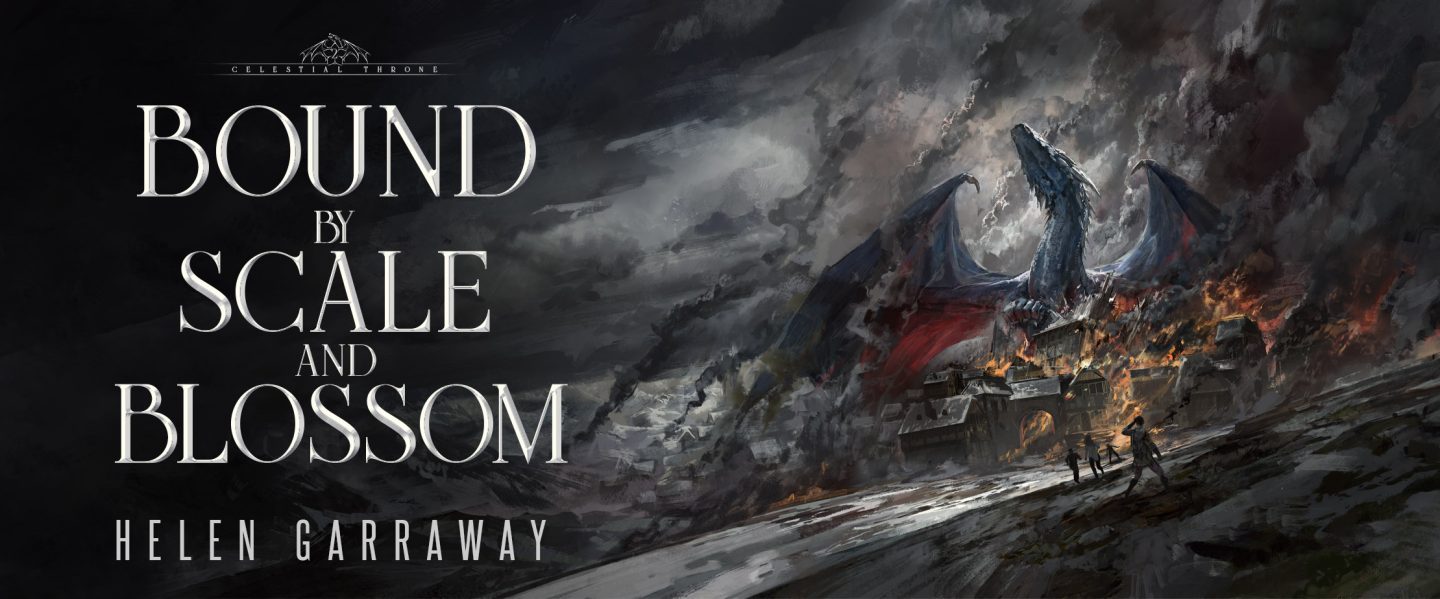
Mark : The cover shows my love for anime style of art and to focus on the two main characters, the Blademancer and the Enchanter. I thought an anime style of art would fit the story and the styling of the characters. The blood moon represents the undead horde of the Ebon Abyss.
Helen: I like the mix of anime and dark fantasy, though it does have a DnD feel to it as well. What made you write this particular book?
Mark: My father passed away on Christmas Eve of 2023. In the months that followed, I spent every other week in my parents house, taking care of my mother and making necessary arrangements while teleworking my regular job. At night, while I sat in that empty house, I think the combination of grief and the sheer emptiness brought this story to life. I wrote it in the three months I was traveling back and forth. I never wrote horror before but I was a big fan of the classic movie monsters as a kid. I think being back in my old home brought those old feelings to surface. I wrote a strong father and mother in the story to emulate my parents. It was a difficult story to write but I needed to do it.
Helen: I found writing to be cathartic as well after such a loss. You typically write Steampunk but you also have a love of fantasy, don’t you?
Mark: I write both fantasy and steampunk. Fantasy has always been a passion of mine. I played D&D in my youth and my early days as a Navy Sailor. It helped to pass the time on long deployments. I also think the world building and character creation helped me in creating the many worlds found within my books. I also write steampunk because of my love for Jules Verne and H.G. Wells. I’ve always loved seeing modern technology in Victorian times and now I have a chance to create my own stories. I love history and being able to combine historical characters with my own in a steampunk historical fiction is fun to write.
Helen: You were obviously in training to be a writer while you were in the Navy! Who is your favourite character from your book?
Mark: I honestly have to say its Duke Jurgen Richter, the Duke of Stormwind and father of Levi Richter, the Enchanter. I emulated my own father in him, a strong military man whose love and devotion for family and country exceeded all. My father was a 22-year veteran of the Marine Corps who did two tours in Vietnam. He inspired me to my own military career in the Navy. I owe everything to my father and I hoped I instilled some of that into Jurgen and how he raised Levi to be the man he became in my story.
Helen: That is such a wonderful tribute to your father. Thank you so much for joining me today. I wish you all the best with your new release. Just to finish, what is the best thing that has happened to you since you began writing?
Mark: Talking with young readers who want to be writers is the best thing imaginable. Knowing that my journey as an author and my stories inspired them is the best feeling in the world. I get to talk to these future authors and help them on their journey is an amazing feeling.
About the Author – Mark Piggott
A native of Phillipsburg, N.J., Mark Piggott enlisted in the U.S. Navy in 1982, beginning a 23-year career. He served on four aircraft carriers and various duty stations as a Navy Journalist before he attained the rank of Chief Petty Officer. He retired from active duty in 2006. He currently works as a writer-editor for the Department of Housing and Urban Development. Mark and his wife, Georgiene, live in Alexandria, Virginia. They have three children.
His first novel, Forever Avalon, was published in 2009. Since then, he has independently published over ten fantasy and steampunk novels, both self-published and through the small press publisher, Curious Corvid Publishing of Geneva, Ohio. Over the years, Mark has won several book awards for his flights of fantasy, including the 2022 AMG Indie Book Awards Grand Prize for Fiction (for The Last Magus: A Clockwork Heart), 2024 finalist for the Golden Wizard Children’s Book of the Year and Canadian Book Club Awards (Gwen Iver and Pendragon’s Puzzle), 2025 NYC Big Book Award and Literary Titan Book Award (Corsair and the Sky Pirates), and The BookFest Book Awards, First Place for Fantasy—Magic, Myths, and Legends (The Last Magus: Dragonfire & Steel).
As an Amazon Associate I may benefit from purchases made using these links.
If you enjoy epic fantasy then check out my award winning Sentinal series, which is now complete. If you like fantasy books with a touch of romance then you will love my SoulMist series, start with SoulBreather. Prefer Dystopian Science Fantasy? Then try Harmony. Start the adventure and stay for the journey.
Sign up to my newsletter and download a free novella called Sentinals Stirring and get notified when my next books are published.
By clicking the sign up button above, you agree to share your email address with the site owner and the newsletter platform provider to receive marketing, updates, and other emails from the site owner. Use the unsubscribe link in those emails to opt out at any time.
By signing up to my newsletter, you agree to receive commercial information from Helen Garraway, located at 61 Bridge St, Kingston, Hertfordshire, UK (Data Administrator). You can withdraw your consent at any time. The data will be processed until the consent is withdrawn.
It’s time to meet Epic Fantasy author, Rebecca Harding,
Helen: Welcome to my blog, Rebecca. I’m very excited to chat to you about your book The Element of Gold which released in January of this year. Tell us a little about your book.
Rebecca: My current book is called The Element of Gold which is book 1 in the Goldstone series. It’s an epic fantasy about the quest for gold and what people are willing to sacrifice for power and wealth. However, it’s ultimately about finding our inner power and magic that exists within all of us – we all have an innate power to heal, grow and be conscious of the amazing life that we all are. The Element of Gold was inspired by The Lord of the Rings, A Game of Thrones, and there are also some elements of Gulliver’s Travels that appear in some chapters as well, so it’s a blend of epic fantasy with some extraordinary, whimsical moments that keep things interesting!
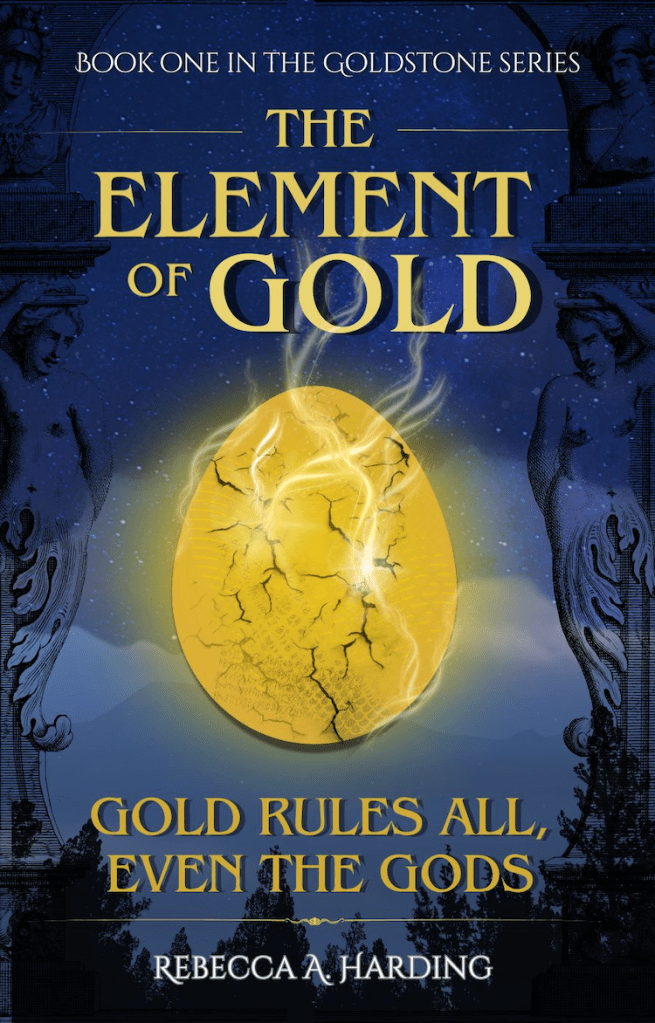
Helen: And your cover? Navy and gold go so well together. What were your thoughts behind the design?
Rebecca: I knew early on that I wanted the cover to be simple and that the Golden Egg would be the focus of the cover. I suppose the Golden Egg is sort of the main character — although there are multiple characters all with their own POVs, all the events unfold around the Golden Egg. So I wanted the Golden Egg to be the star of the cover!
Helen: Writing can be a bit addictive, I know I’m always plotting new stories. What are you currently working on?
Rebecca: My current WIP is the next book in the Goldstone series, so please keep a look out for its release probably sometime next year (although as writers, we know that the release date is often a large dose of wishful thinking!)
Helen: Best laid plans and all that! At least being Independently published we can set our own deadlines. I know this is a difficult question, but who is the favourite character you have written?
Rebecca: My favourite — don’t tell my other characters because they’ll probably give me insufferable writer’s block for the next book — but it’s probably Kyra.
Helen: So if your main character could tell us why to read your book, what would they say?
Rebecca: It’s hard to pinpoint a ‘main’ character in The Element of Gold, as I enjoyed creating several characters with their own spirits and journeys, but Kyra would say ‘read this book if you’re on a journey of reclaiming your power – in whatever way that looks like to you, this book will remind you about your incredible strength!’
Helen: Thank you so much for spending time with me today. I wish you all the best with your books. Just to finish, what is the most useful piece of writing advice you’ve received that you would share with other writers?
Rebecca: However you need to write your book — if that means writing at 2am, writing in a notebook, or writing upside down while riding a bicycle! — it doesn’t matter, just write the book! Put your perfectionist mind to the side and just allow the creativity to flow without judging it. The critic can return later when it’s time to edit, but don’t allow it to stop you from finishing your book — because it’s not just words on a page, it’s your voice and your unique journey.
About the Author – Rebecca Harding
Rebecca Harding is a fantasy author whose writing blends a deep love for the natural world with ancient philosophy and rich spirituality. Born in Hertfordshire, England, she spent her formative years exploring local woodlands and questioning the mysteries of existence — passions that naturally wove themselves into her storytelling.
Her debut novel, The Element of Gold, marks the beginning of her journey as a world-builder, exploring complex themes of inner power, elemental forces, and the unseen threads that connect all living things. When she isn’t writing or getting lost in philosophical debates, Rebecca can usually be found hiking, meditating, or looking for magic in the everyday.
As an Amazon Associate I may benefit from purchases made using these links.
If you enjoy epic fantasy then check out my award winning Sentinal series, which is now complete. If you like fantasy books with a touch of romance then you will love my SoulMist series, start with SoulBreather. Prefer Dystopian Science Fantasy? Then try Harmony. Start the adventure and stay for the journey.
Sign up to my newsletter and download a free novella called Sentinals Stirring and get notified when my next books are published.
By clicking the sign up button above, you agree to share your email address with the site owner and the newsletter platform provider to receive marketing, updates, and other emails from the site owner. Use the unsubscribe link in those emails to opt out at any time.
By signing up to my newsletter, you agree to receive commercial information from Helen Garraway, located at 61 Bridge St, Kingston, Hertfordshire, UK (Data Administrator). You can withdraw your consent at any time. The data will be processed until the consent is withdrawn.
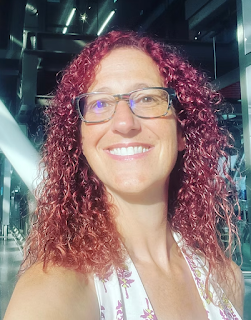
It’s time to meet Historical Fiction author, Lisajoy Sachs. I’m excited to talk to Lisajoy about how her family history inspired her book.
Helen: Welcome, LisaJoy. It’s great to have the opportunity to talk to you about writing journey. Thank you for joining me today. Tell us about your latest book.
Lisajoy: Bright One is a historical novel based on true events, following a mother and daughter in Romania during a time of rising uncertainty and danger. At its heart, it is the story of Jetti and her young daughter, Berta, whose bond is tested as the world around them begins to shift. Set against the backdrop of pre-war Eastern Europe, the novel explores love, resilience, identity, and the quiet strength it takes to protect one’s child when everything familiar begins to unravel.
Helen: With such deep emotional themes, how did you come up with the cover design?
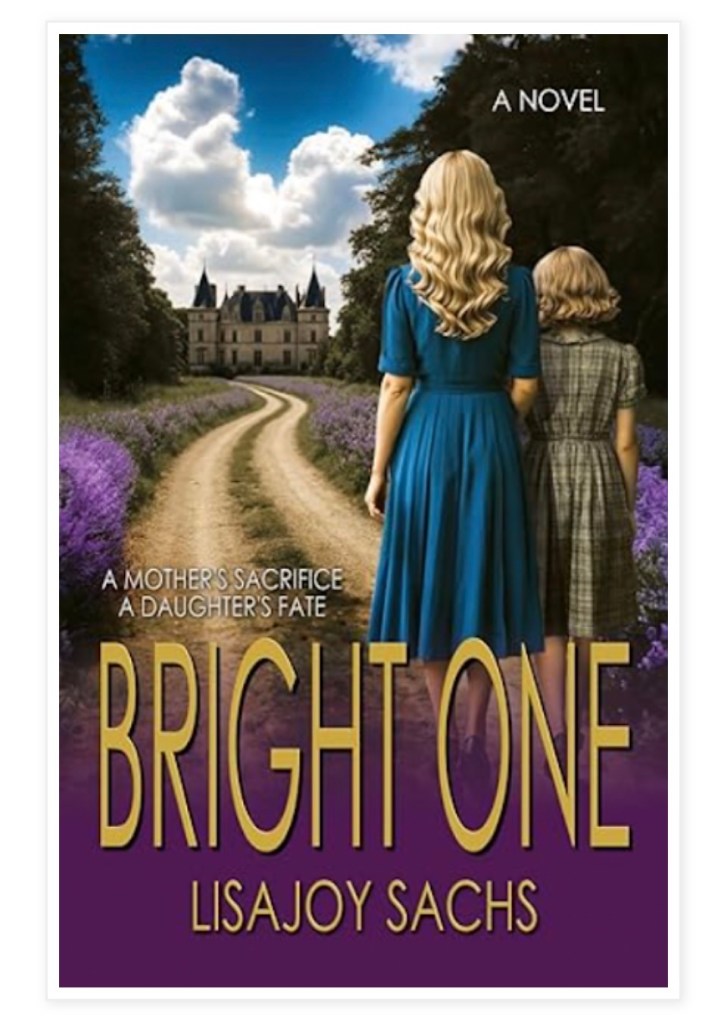
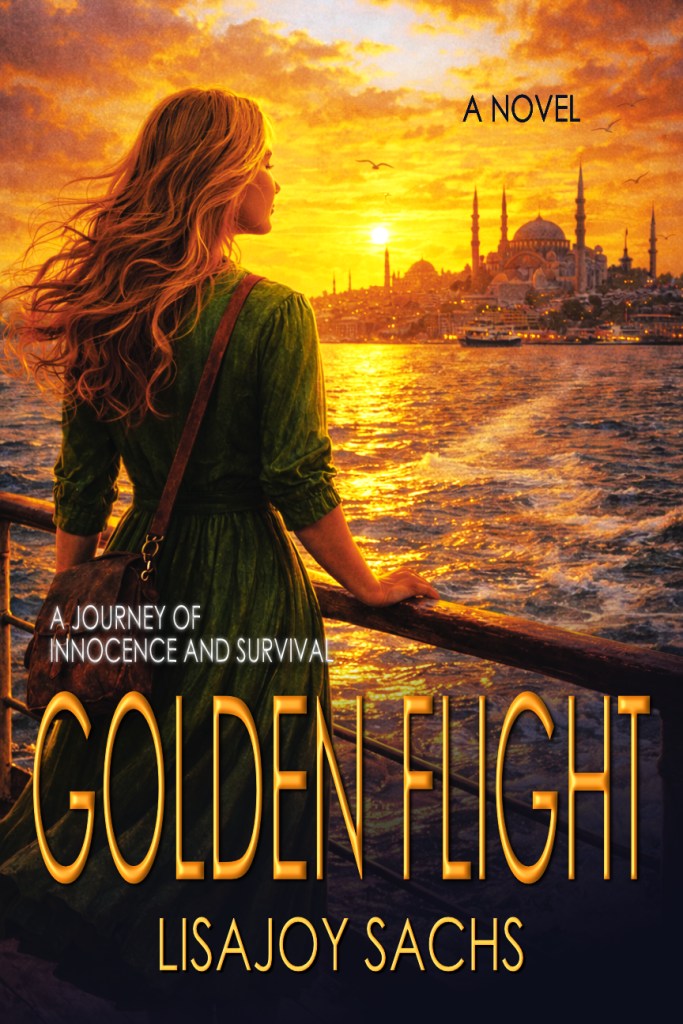
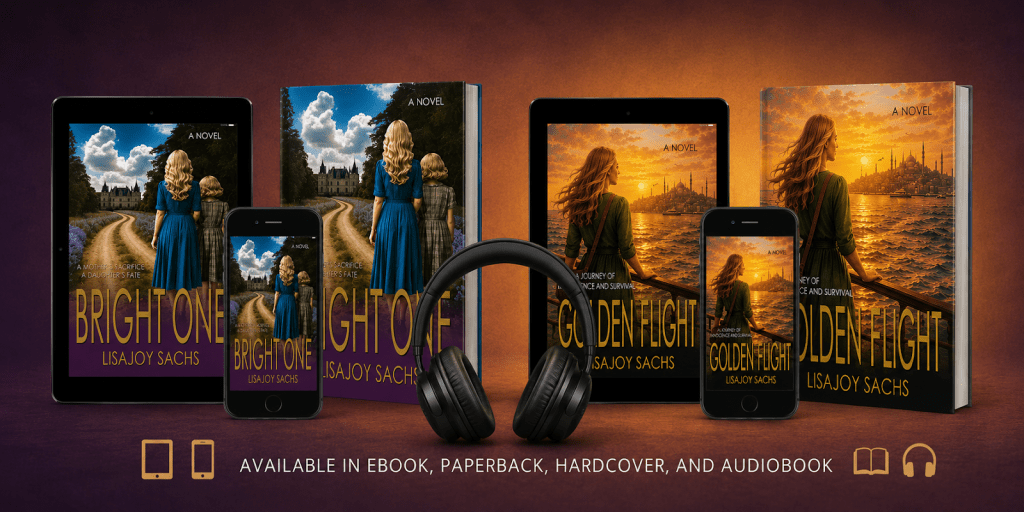
Lisajoy : The cover features my great-grandmother, Jetti Finkelthal, and her daughter Berta, my grandmother, standing at the end of the driveway of the mansion where they once lived. They are turned toward the house, not facing the viewer, which makes the moment feel both intimate and distant.
This image captures a pivotal emotional truth at the center of the story: the moment before departure. It symbolizes Berta leaving behind the only home she has ever known, along with the safety, innocence, and stability it once represented. The mansion stands not just as a place, but as a memory, something already beginning to slip into the past.
Helen: And how did you come up with the title?
Lisajoy: The title Bright One came to me during the research process, while I was translating family letters and historical documents. In that work, I discovered that the name Berta, in High German, translates to “Bright One.”
That moment felt significant. It wasn’t just a linguistic detail, it captured something essential about her spirit and her role within the story. The title reflects both who she is and what she represents: light, resilience, and endurance in the face of darkness. From that point on, I knew it wasn’t just the title of one book, but the foundation for the entire series.
Helen: I know the characters are based on members of your family, but why did you decide to write this book?
Lisajoy: I wrote Bright One because it is part of my legacy. I don’t have children, and my sister doesn’t either, so I felt a deep responsibility to preserve my family’s story in a meaningful, lasting way.
This book is how I carry their voices forward. It ensures that the lives, struggles, and resilience of those who came before me are not forgotten. In many ways, it is something I am leaving behind, and a way for future readers to connect with their history, and for my family’s story to continue long after I’m gone.
Helen: That is a wonderful way to preserve your family history. Can you tell us a little more about your main protagonist?
Lisajoy: In Bright One, Jetti is the central protagonist in the first part of the story, with her daughter Berta following closely behind in the second half. As the series continues into Golden Flight, Berta becomes the primary protagonist.
I chose both of them because they are the voices through which my family’s story in Romania before the outbreak of World War II needed to be told. Each of them carries a different perspective, and together they create a fuller, more intimate understanding of what that time was like.
As for the rest of the series, the focus will continue to evolve…but you’ll have to wait to discover whose voices come forward next.
Helen: I love the fact that there is the next episode of your family history coming. Why did you choose to write historical fiction?
Lisajoy: I write historical fiction because it allows me to honor real people and real events while also giving me the space to tell a complete story. Much of my work is rooted in the lives of family members who are no longer living. I only have fragments, like stories, letters, memories that were passed down to me, but not every detail.
Historical fiction gives me the ability to bridge those gaps thoughtfully, creatively, and respectfully. It allows me to stay true to the emotional and historical reality of their experiences, while imagining the moments that were never recorded, so their stories can be fully realized and shared.
Helen: You mentioned that you were writing the second book in the series, can you tell us more about it?
Lisajoy: I’m currently preparing Golden Flight, the second book in the Bright One series, for release this July. I’m in the final editing stage now, where the manuscript feels nearly ready for publication.
At the same time, I’m close to completing Aliyah Rising, the third book in the series, which I plan to publish in mid-2027. Beyond that, the full arc of the story is already taking shape. I have three additional manuscripts completed—Folding Light, Restoring Hope, and Fading Night—that will follow, finalizing the six-book saga.
It’s incredibly meaningful for me to see the entire series unfolding, from the early stages of discovery to a fully realized, multi-book journey.
Helen: How did the idea for writing this series start?
Lisajoy: The ideas for my books began with something deeply personal. When my grandmother died in 2004, I inherited boxes of ephemera from her home. Inside, I found letters, documents, and photographs that revealed a story I had never known.
Through translating those materials, studying DNA records, and conducting historical research, I was able to piece together what happened to my great-grandmother and her siblings. She was one of nine children. As that story came into focus, the fragments I had learned over the years from living family members suddenly made sense.
What started as discovery became narrative. My books grow from the process of uncovering hidden histories and bringing them to life in a way that connects the past to the present.
Helen: You mentioned you had to translate a lot of material and records, but as your books are based on real life history, you must do a lot of research. How much time did you spend researching?
Lisajoy: That’s such a loaded question…because writing historical fiction requires an enormous amount of research. I spend a great deal of time reading, studying, and cross-referencing other sources to make sure I truly understand the world I’m writing about.
My process may not be traditional, since I don’t come from a formal writing background, but accuracy is incredibly important to me. I pay close attention to the details, everything from clothing and food to hairstyles and the social atmosphere of the time.
For me, those specifics are what bring the story to life and make it feel authentic. If the details are right, the reader can fully step into that world.
Helen: It must be so interesting finding out about your own history. Once you start, I imagine it can like going down a rabbit hole. What do you find is the most challenging part of writing?
Lisajoy: Editing without a question is the most challenging part of the process for me. It requires reading the manuscript over and over again, sometimes ten times or more before the final galley is due, and that can be incredibly grueling.
There’s a mental and emotional toll to that level of repetition. The more I read it, the more I begin to question it…every sentence, every choice…until I start to doubt whether it’s any good at all. It’s a difficult phase because it demands both precision and resilience. But once the book is finally published, there’s a sense of clarity and confidence that makes the entire process worthwhile.
Helen: Are you a Pantser or a Planner? Do you write free form, or do you have a framework you stick to?
Lisajoy: For most of the Bright One series—Bright One, Golden Flight, Aliyah Rising, Folding Light, and Fading Night—I was very much a Pantser. I start with an idea and let the story unfold naturally, writing intuitively and following where the narrative lead. My focus in those early drafts is to tell the story as honestly and vividly as possible.
Then, during the editing and proofreading stages, I shift gears. That’s when I go back and refine the work ensuring that the historical details are accurate and strengthening the emotional, cinematic quality of my storytelling.
Restoring Hope was different. Because I had the opportunity to interview the protagonist in person, I worked from a loose outline. It required a more structured approach to stay true to the real-life events while still capturing the sense of adventure and depth the story deserved.
Helen: How do you fit your writing into your day job?
Lisajoy: For me, it comes down to consistency and making writing a daily priority. I dedicate a small part of each day just for writing, even 15 minutes, which ultimately turns into more once I start writing, and I stick to it.
Even when life gets busy, having that set time keeps me connected to the work and ensures steady progress. It doesn’t have to be hours at a time; what matters most is showing up every day and committing to the process.
Helen: There are many hidden joys in the writing journey. What is the best thing that has happened to you since you began writing?
Lisajoy: The most meaningful part of this journey has been how much closer I’ve become to my family. Through writing, I’ve uncovered stories about my parents and their past that I might never have known otherwise. It’s deepened my understanding of where I come from in a very personal way.
At the same time, I’ve been incredibly moved by how readers connect to my work. Many have reached out to share their own family histories and experiences, and in some cases, I’ve been able to weave elements of those stories into my books. That exchange, between past and present, between my story and theirs, has been one of the most rewarding aspects of writing.
Helen: What is the most useful piece of writing advice you’ve received, and by whom?
Lisajoy: The most valuable advice I received came from a ghostwriter named Marilyn, whom I met at an art opening a few years ago, when I had only completed a few chapters. She told me to write 600 words every morning, first thing, for three months, promising that I would have a finished manuscript by the end of it.
I took her advice seriously, and it worked. At the time, I wasn’t working, which allowed me to dedicate several hours each day to writing. What started as a disciplined daily routine quickly became something much bigger. I ended up completing the first four books in just three months.
That experience was transformative. It showed me the power of consistency and immersion, and how giving yourself the time and structure to write can unlock far more than you expect.
Helen: Writing everyday is a great habit to cultivate. Most authors are also great readers. What is your favourite book?
Lisajoy: My favorite book is The Pillars of the Earth by Ken Follett. I’ve read it at least six times, and each time I find something new to appreciate.
I’m drawn to the characters, the richness of the story, and the incredible level of detail. It introduced me to a period of history I knew very little about, and I love how fully immersive it is. I’ve always been captivated by epic novels. There’s something deeply satisfying about getting lost in a world that unfolds inside a thousand page novel.
In fact, I’m always a little sad when I reach the final chapter of a book like that. I even own a first edition copy from 1989, which makes it feel even more special to me.
Helen: Do you have any advice to share with aspiring writers?
Lisajoy: First, I would pass along the same advice Marilyn gave me: write consistently. Set a daily goal, something manageable, like 600 words, and commit to it. That kind of discipline builds momentum and turns an idea into a finished manuscript.
Second, don’t give up on your dream. So many people want to write a book, but very few actually follow through and see it published. The difference often comes down to persistence.
Third, there will be moments when it feels hard, and times when you question yourself or feel like an imposter. That’s completely normal, because it is part of the process. Writing isn’t easy, but it is deeply rewarding when you finally hold your finished work in your hands.
Helen: Thank you so much for joining me today. It’s been so interesting to hear about your books and your writing process. I wish you every success with your series. Just to finish, is there anything else you would like to share?
Lisajoy: One of the most unexpected and meaningful parts of this journey has been how the past seems to reveal itself when you’re ready to listen. What began as a few boxes of old letters and photographs turned into a much larger story, one that had been waiting to be uncovered.
There were moments during my research when small details such as names, places, and fragments of family stories suddenly connected in ways that felt almost serendipitous. It was as if my ancestors were guiding me, piece by piece, toward understanding.
And now, what started as something deeply personal has become something shared. Hearing from readers who see their own families reflected in these pages has been incredibly moving. It reminds me that while the details of our histories may differ, the emotions of love, loss, and resilience are universal.
About the Author – LisaJ=joy Sachs
Inspired by true events, family letters, photographs, and oral histories, the Bright One series follows the lives of the author’s great-grandmother and grandmother as they struggle to survive the rising dangers of antisemitism in prewar Europe.
Beginning in Czernowitz, Romania, Bright One tells the story of Jetti Finkelthal, a young Jewish mother determined to protect her daughter as the world around them begins to unravel. Golden Flight continues the journey through the eyes of fifteen-year-old Berta, whose forced marriage and desperate migration across Europe and Istanbul become a haunting coming-of-age story shaped by exile, identity loss, and survival.
Rich in historical detail and emotional depth, the series explores resilience, family bonds, generational trauma, and the quiet courage required to endure history’s darkest moments.
As an Amazon Associate I may benefit from purchases made using these links.
If you enjoy epic fantasy then check out my award winning Sentinal series, which is now complete. If you like fantasy books with a touch of romance then you will love my SoulMist series, start with SoulBreather. Prefer Dystopian Science Fantasy? Then try Harmony. Start the adventure and stay for the journey.
Sign up to my newsletter and download a free novella called Sentinals Stirring and get notified when my next books are published.
By clicking the sign up button above, you agree to share your email address with the site owner and the newsletter platform provider to receive marketing, updates, and other emails from the site owner. Use the unsubscribe link in those emails to opt out at any time.
By signing up to my newsletter, you agree to receive commercial information from Helen Garraway, located at 61 Bridge St, Kingston, Hertfordshire, UK (Data Administrator). You can withdraw your consent at any time. The data will be processed until the consent is withdrawn.
It’s time to meet YA Fantasy author, Paul R. Somerville, who I met a local book fair in Farnham, and he is here to talk about his books.
Helen: Welcome, Paul. It’s great to have the opportunity to talk to you about writing journey. Thank you for joining me today. Tell us about your latest book.
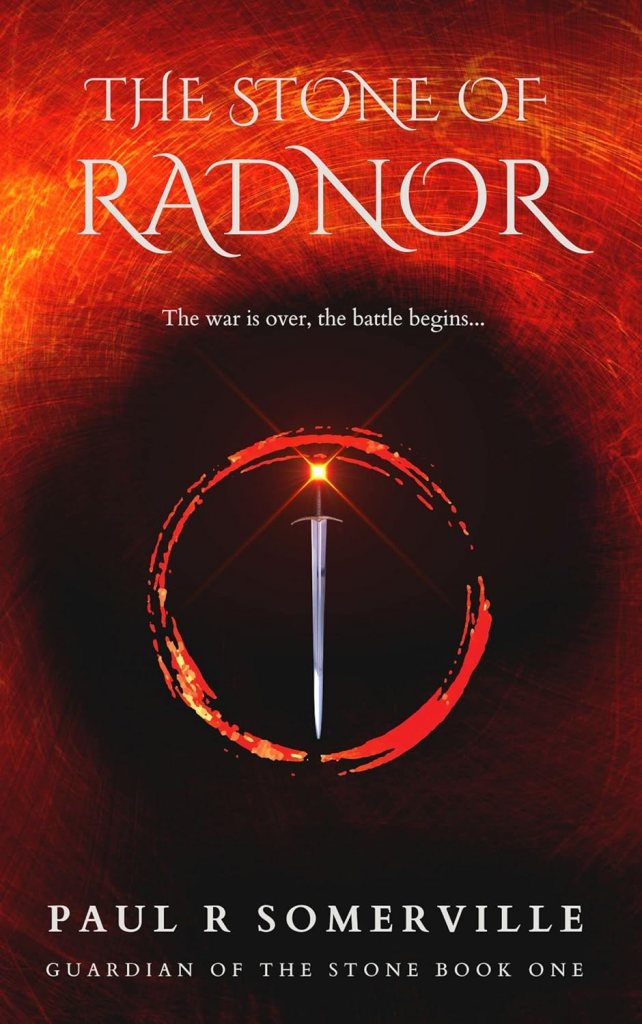
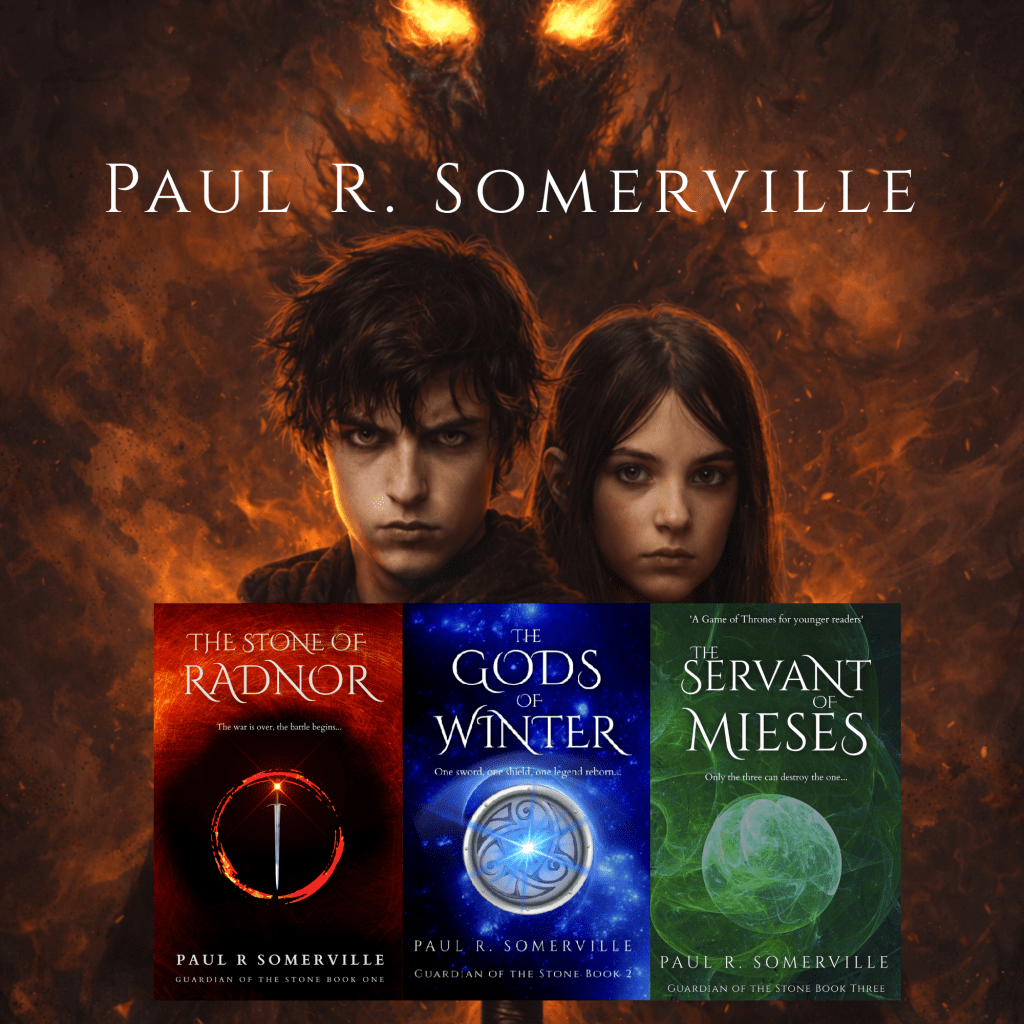
Paul: It’s actually a trilogy, called Guardian of the Stones. Three books which follow the fate of Jaydon, a fourteen year old boy whose world is turned upside down when his whole family and village are destroyed. I’ve set the story in a land and time similar to Saxon age England, in fact I’ve taken many influences for my world building from the dark ages and early medieval Britain… even with twists on Celtic mythology.
In book one, The Stone of Radnor, I really put poor Jaydon through the mill in the early parts, as he’s left orphaned, homeless and eventually captured and forced into slavery. But he swears revenge on his the man who murdered his family after finding his father’s sword in the rubble of his home. It soon transpires that there is more to this sword than Jaydon ever knew, as his journey takes him on an unexpected quest, with unexpected consequences – all beginning with a companion, a young servant girl called Raven, who helps him escape. Jaydon discovers he is the guardian of the stone of Radnor, a magical god-stone on the pommel of his father’s sword.
In Book Two, The Gods of Winter, Jaydon has been sent by the High Priestess of Mieses to seek out an old warlock called Gunlak, who has, for 500 years, hidden himself away from the world. The evil god Elokar is raising and army and as the Guardian of the Stone of Radnor, it’s down to Jaydon to unite the remaining three god-stones, and Gunlak owns the Stone of Onir – yet no-one knows where is hiding. Jaydon’s sets of with Raven and his friends, their journey takes them across a vast ocean, but a vicious storm forces them to abandon the ship and seek shelter in the arctic islands called The Sisters, winter is coming, yet the islands are littered with warring tribes and hungry snow bears. Jaydon must befriend these tribes and seek help finding Gunlak – yet he finds war and clashing religions which put his friendship with Raven into jeopardy. For the arctic tribes I mixed both Mongolian and Inuit cultures to create the contrast that Jaydon had known on the mainland to challenge his beliefs and naïve view of the only world he had known.
The final book is called The Servant of Mieses. Jaydon has reunited the three god-stones, but Elokar’s armies march northwards to war. Jaydon must get a ship back home to stop him. The tribes of The Sisters believe him a god, and follow him, yet despite the end of winter and the oncoming thaw, the land is treacherous and the only way of getting a ship is to get to the remote northern outposts of the islands. In book two, Gunlak had told Jaydon of the coming of Amraeth – the one who will defeat Elokar – and it was down to Jaydon as the Guardian of the Stones to face Elokar and bring Amraeth forth. But he does not know how, his army is small and he feels hopeless and out of his depth. Yet help comes from an unexpected source as he faces Elokar in a final battle.
Helen: What a thrilling adventure for young and older readers alike! Your covers go so well together, how did you come up with the designs?
Paul : One of the joys of being self-published is the full control we have over our own works, that includes the covers. I always had an idea of roughly what I wanted to do for my covers, specifically half-way through The Stone of Radnor when I realised I was writing a trilogy. Quite honestly I used the red, blue and green colours to represent three of the four god-stones in the books, red for Radnor, blue for Onir and green for the evil entity, Elokar. I was thinking of hiring someone to design them for me, but I love the creative element, so using online design tools I set to create each one myself.
The cover of the Stone of Radnor represents Jaydon’s sword with the red god-stone on the pommel. I have been told it gives a LOTR feel, which wasn’t intentional but plays into the fantasy feel I wanted.
The Gods of Winter has a shield on the cover, which is representative of the Shield of Edora from the book, a magical shield that comes into Jaydon’s possession.
Finally, The Servant of Mieses, keeps the central ‘circular’ theme from the first two, but the colour representing Elokar’s god-stone, however the ethereal globe in the centre covers two things – the Stone of Mieses (a white globe) and the final climax of all the stones coming together (sorry no spoilers to explain more).
Personally I feel the covers represent the story well and do draw the eye.
Helen: The Guardians of the Stones trilogy is YA Fantasy. Is that the main genre you write?
Paul: I write fantasy – I read a lot of historical fiction, and what I enjoy is bringing real historical stories into my own world and fantasy-based settings. The world across the Guardian of the Stones series is called Calaria, and uses lots of real-historical references through research that I have done; for example, in the Gods of Winter, Jaydon needs to find the magical Shield of Edora to save a friends life – this idea sprung from historical myths around King Arthur and his search for the Cauldron of Anwr in what is now Anglesey.
I just love the idea of the creation of my elements from my own imagination – including those elements that bring more realism, aside from maps (which are in the books) I have created a language called Calar Ahunn (Old Calarian) – which is used sporadically through the books for prayers and magical components. The language is unique, but based on forms of Nordic, including a rune-based alphabet.
I have been heavily influenced by what I read – which includes both epic fantasy and historical fiction – with Bernard Cornwell’s Last Kingdom series of books being my main influence, the way he develops character and seeps you into his world I find completely inspiring.
In essence, writing fantasy allows my imagination to flow and run wild and re-use existing myths, legends and historical stories and create and morph them into my own world.
Helen: Isn’t it wonderful how the books we grew up become our inspiration as we go forward. I hope my books one day inspire others to write. With your books having such a historial influence, do you find you have to plan your books, or are you more of a pantser?
Paul: Oh – a complete pantser, which at times is amazing as I never know what direction my characters will take me in. But sometimes that’s to my detriment as, I have, on occasion, got myself in a pickle. A creative writing group covered this in an exercise and put this in an interesting term – you’re either a gardener or an architect. A gardener plants seeds, nurtures them and sees how they grow, never really knowing what they will grow to be like – if the fruits will actually appear. Whereas an architect works to a detailed plan that they have already sketched out.
Having said that, I do usually have an idea of how my stories end (sort of) and although not sure quite how I will get there, it gives me a point to aim for. In fact, as I get closer to the end – usually about two-thirds of the way through – I start to map out chapters, writing a paragraph on each, stating what I want it to cover, and asking myself any questions that I still need an answer to. One piece of advice I was given was to treat each chapter like a mini-story, with a beginning, middle and end – having an objective for each one.
I do need to plot a little more in my current WIP, I have realised the middle part of the book has become a little muddled and I’m not quite sure of the motivations of my side-characters, which has allowed my protagonist to become too passive. So, I am undertaking an exercise to plot out their goals and needs a little more.
Helen: That is some great advice. I thought you might have been more of a planner! You mentioned your WIP. Can you tell us what you are working on next?
Paul: I’m currently have two projects on the go – one a little more advanced than the other. The main project, The Emerald Passage, is a fantasy / sci-fi – using the premise of climate change as the catalyst for my protagonist become the centre of this change.
Earth has a sister planet called Galea, many light years away, which is linked by a secret portal. The portal’s existence is protected by a secret society of humans from both planets – however they follow a supreme entity called The Being, who is dying and the secret society need to save both worlds to protect The Being and save Earth and Galea in the process.
I based this premise on stories I researched on Thoth the Atlantean an Egyptian deity of wisdom, described in literature as an immortal Priest-King who survived the sinking of Atlantis, and mashed it with existing stories written by conspiracy theorists who claim that aliens live among us. I guess it’s become cross between a Dan Brown novel and Stargate.
My other WIP is called The Cursed Crown. This is still very much in the very early stages of development, but I’ve taken the premise of what happened when Emperor Nero died and the Roman Empire was thrown into civil war, with four emperors in a year. I am this premise into my own fantasy world – with the view point of my main character, who is a close friend to the man who ends up as the final emperor during this period of chaos. A long way to go, but one I am excited about.
Helen: You are very busy!! I wish you all the best with your books. Thank you so much for spending time with me today. Just to finish, what is the most useful piece of writing advice you’ve received, and from whom?
Paul: I’m certainly never short of being given advice!! 😊 I’ve been attending a creative writing group on and off for 6 years now. My tutor (Mel) is amazing and provides constant support and encouragement. The best advice she has given me is , write, write, write – even if it’s just a few words, just get it down. It doesn’t matter how good or bad it is, refining is the editing process.
I recently listened to Stephen King’s On Writing audio book. Although I don’t necessarily agree with everything that he said, he does say ‘Write the first draft with the door closed, the second with the door open.’ What he means by that is that the first draft you are writing for yourself, with the doors closed. Then you open the door and you are rewriting your story to the outside world, to your readers. I liked that analogy as I do tend to get myself bogged down trying to perfect a piece of prose or descriptive text on some scene, when actually I should just get the darn story written.
Being a self-published author, I’ve learned a lot through my own mistakes too. I certainly did with my first book – editing was a chore, and it’s costly paying someone to do this professionally, but that means that errors in grammar and typo’s creep in. It is definitely worth getting this done properly – and I’ve certainly had those errors pointed out to me after pressing the ‘publish’ button on KDP!!
Lots of people though have given me advice on what comes next, marketing, promoting etc. Every time I attend an event with other writers I learn more. One thing I have discovered is that the writing community, especially self-published and indie writers, are an amazing and helpful bunch of people, really supportive – I guess I now need to listen to that advice and become less of a luddite where social media and book promoting is concerned?
About the Author – Paul Somerville
Born in Burnley, Lancashire, Paul joined the British Army at the age of just 16 and served until 1999, having travelled widely (Norway, USA, Canada, Alaska, Germany, Belgium, Italy, Turkey, Portugal, Denmark, Croatia, Bosnia, Gibraltar) and completing three operational tours in the Former Yugoslavia during the Balkan conflict.
Since leaving the army Paul has worked in a variety of roles and organisations – but moved into Cyber Security, and is now a Principal Consultant for a UK based consultancy. Paul has lived in Malvern, Rugby, Farnham and now resides in Alton, Hampshire, with his two children, a mad-cat, two gerbils and several fish.
Outside of writing and work Paul is an avid supporter of Burnley FC and enjoys walking in the Hampshire and Surrey countryside and taking mini-adventures in his twenty-five year old campervan.
As an Amazon Associate I may benefit from purchases made using these links.
If you enjoy epic fantasy then check out my award winning Sentinal series, which is now complete. If you like fantasy books with a touch of romance then you will love my SoulMist series, start with SoulBreather. Prefer Dystopian Science Fantasy? Then try Harmony. Start the adventure and stay for the journey.
Sign up to my newsletter and download a free novella called Sentinals Stirring and get notified when my next books are published.
By clicking the sign up button above, you agree to share your email address with the site owner and the newsletter platform provider to receive marketing, updates, and other emails from the site owner. Use the unsubscribe link in those emails to opt out at any time.
By signing up to my newsletter, you agree to receive commercial information from Helen Garraway, located at 61 Bridge St, Kingston, Hertfordshire, UK (Data Administrator). You can withdraw your consent at any time. The data will be processed until the consent is withdrawn.
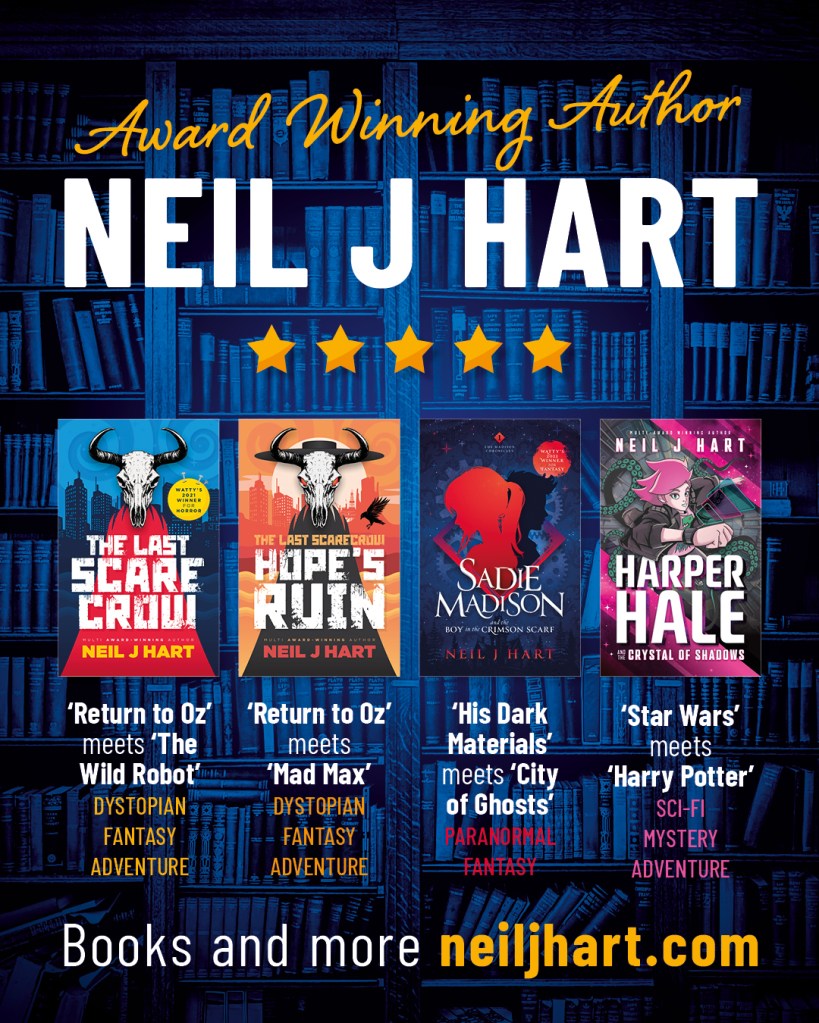
Having met Neil J Hart at many book fairs, I’m delighted to welcome him onto my blog. Let’s find out more about his writing process and his latest book Hope’s Ruin.
Helen: Welcome, Neil. I’m so excited to chat with you today. Tell us about your latest book.
Neil: I’ve just released ‘HOPE’S RUIN’’ the second book in my ‘Scarecrows of Coldharbour Farm’ series. These books are set against the backdrop of a climate disaster that has washed away humanity and sucked the earth dry. Spirits now inhabit scarecrows and mannequins and wickermen who fight for supremacy of the seas and the skies. And among them live the last of humanity, struggling desperately to survive.
‘Hope’s Ruin’ picks up about a year after the events of book one – ‘THE LAST SCARECROW’ – and continues to follow Erin (the last human girl), Raven (a belligerent talking bird), and a host of strange monsters, villains, and scarecrows as the battle to save the ones they love.
‘Hope’s Ruin’ expands the universe we discovered in ‘The Last Scarecrow’. With the oceans now washed away, Erin and Raven meet survivors carving out an existence in a remote township called Hope’s Spark in the Great Wastes and a thriving community who live in caves beneath a vast mountain range. But a new evil is rising, more powerful and deadly than the last. Erin and Raven must risk it all as they travel to the plughole of the world and into the savage skies to uncover a mighty power that can turn the tide and bring balance and peace to the world.
Helen: Your covers are so striking. How do you come up with the ideas?
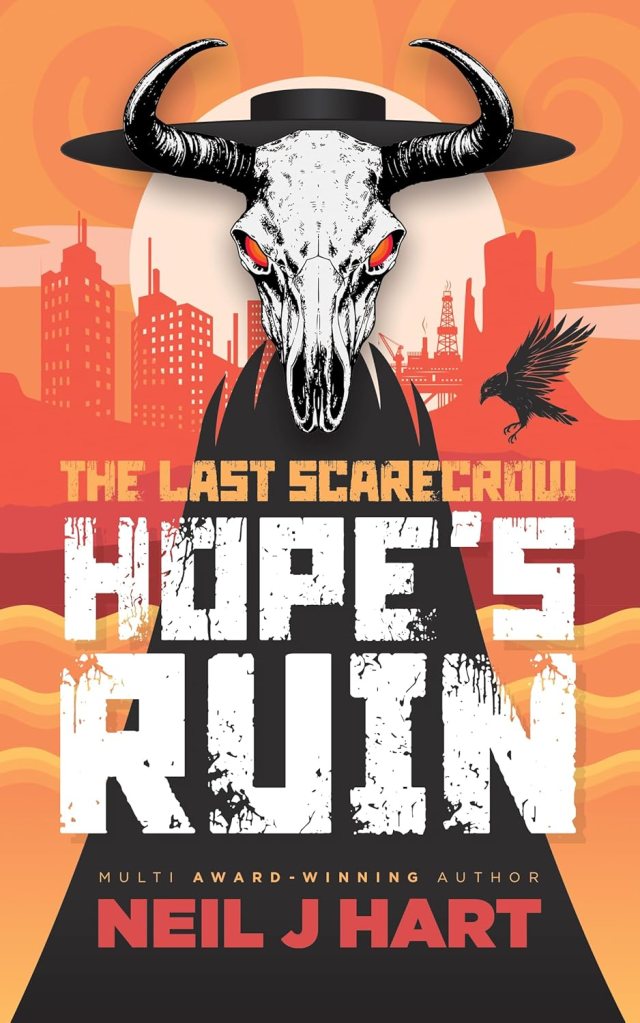
Neil : I’ve worked as a professional graphic designer for twenty five years so I do all my own covers and artwork. This is a huge advantage as I can craft exactly what I want. This also means I end up making over a hundred designs for each book and takes me weeks and weeks.
The process for ‘Hope Ruin’ followed the same design direction as ‘The Last Scarecrow’. I knew the central character of scarecrow Number Twelve would be a dramatic vision for the cover so I wanted to put her front and centre, surrounded by locations and meteorological references to the story. ‘The Last Scarecrow’ feature Number Twelve stood before a submerged city while storm clouds and stars lingered overhead.
In ‘Hope’s Ruin’ she stands in a vast wasteland. Desiccated cities and mountains rise behind her along with a remote drilling platform, all present in this new story. Number Twelve has also changed a little from the first book. Instead of her red flowing garments she now opts for black, wears a wide-brimmed hat, and her eyes glow red. This signals a major change in our central character, one filled with jeopardy and menace.
Helen: You are the second author I’ve interviewed recently who creates their own covers. You are all such a talented bunch! Who inspired you to start writing?
Neil: I hated books as a child. I’d much rather watch movies and TV shows. But when my Mum brought home copies of Ian Livingstone’s Fighting Fantasy books I was immediately converted. Livingstone’s Choose Your Own Adventure style books didn’t feel like ‘normal’ reading. There weren’t hundreds of pages to go until the end. There were short paragraphs followed by a decision – you turn left, you eat the wild mushrooms, you fight a bloodbeast etc – which all lead to different outcomes that you had some control over. I swiftly advanced to Terry Pratchett’s Discworld books and that’s what really sparked my love of writing. I found Terry’s backwards, satirical, humorous approach to fantasy far more digestible than the lengthy tomes of Tolkien et al.
Helen: It is to our benefit that you found a love of reading. Everyone has a different path, I’m so glad you found one that worked for you. What are you working on next? Is there another Scarecrow book?
Neil: I’m currently writing the third and final book in the ‘Scarecrows of Coldharbour Farm’ series. Where the first book was set on water, the second on sand, this one ventures north. This book looks a little longer than the previous two, featuring huge set-pieces, epic battles, desperation, hope, and the most peculiar band of friends the world has ever known. More info on this coming later in 2026 including title name and cover reveal.
Helen: How exiting! Readers watch this space. Let’s chat a little about your writing process. Do you plan your books or are you a pantser?
Neil: I plan. A lot. Usually, after weeks of note taking and long walks, I’ll write a long synopsis of the entire story. Around five thousand words. I’ll then break that into thirty or forty chapters, with two to three scenes in each. Each scene and chapter has a sentence that explains what happens, the emotion tone, character points.
Then I sit and draft the whole book, joining scene to scene, chapter to chapter, taking notes and outlining potential issues or better character arcs as I go. I’ll leave the first draft for a few weeks, outline something new, then come back and read through, consult my notes, change the ending usually, and remove repetition, irrelevance, nonsense, and trim about twenty percent of the words to make it slick and pacey.
I believe nothing is perfect so when the book is ready, when I’ve read it about twenty times and thrown every idea I can at it, it goes to my editor. I know I’ll have new ideas in the future, perhaps better ideas, but if I sat around waiting for those to come along I’d have a dozen never-finished books.
Helen: Although I started as a pantster, the more I’ve written, the more I plan. Thank you so much for spending time with me today. Just to finish, tell us about your favourite book and why you like it so much.
Neil: I have so many favourite books and authors but the one I always reach for when asked this question is His Dark Materials by Philip Pullman. It has everything I love in a story: epic adventure, mysterious powers, monumental world-building, unusual friendships, heartbreak, danger, and brilliant villains. What really sets HDM apart from other books with these tropes is Pullman’s use of dæmons. Each character has their own unique mystical ghostly animal or creature (of the opposite gender) that represents their soul / nature. This is used to magnificent effect, allowing readers to understand the nature of each character by what dæmon accompanies them and to showcase the relationships between each character and their dæmon: a window to their hope, dreams, subconscious thoughts, fears, and soul.
About the Author – Neil J. Hart
Neil J Hart has won awards for his haunting YA fantasy novels ‘The Last Scarecrow’ and ’Sadie Madison and the Boy in the Crimson Scarf’ and is working on sequels to both. ‘Harper Hale and the Crystal of Shadows’ was released in May 2025 and is the first book in a new sci-fi mystery adventure saga. Neil also works as a graphic designer and a musician. He fosters for Cats Protection. Relies on coffee. Adores cheese and cucumber sandwiches. And collects Tomb Raider memorabilia.
As an Amazon Associate I may benefit from purchases made using these links.
If you enjoy epic fantasy then check out my award winning Sentinal series, which is now complete. If you like fantasy books with a touch of romance then you will love my SoulMist series, start with SoulBreather. Prefer Dystopian Science Fantasy? Then try Harmony. Start the adventure and stay for the journey.
Sign up to my newsletter and download a free novella called Sentinals Stirring and get notified when my next books are published.
By clicking the sign up button above, you agree to share your email address with the site owner and the newsletter platform provider to receive marketing, updates, and other emails from the site owner. Use the unsubscribe link in those emails to opt out at any time.
By signing up to my newsletter, you agree to receive commercial information from Helen Garraway, located at 61 Bridge St, Kingston, Hertfordshire, UK (Data Administrator). You can withdraw your consent at any time. The data will be processed until the consent is withdrawn.
It’s time to meet author, Brooke Gillespie-Trout and find out about her writing journey and her book Executive Decisions
Helen: Welcome, Brooke. It’s wonderful to have you on my blog. Congratulations on releasing your book Executive Decisions on May 12th. Tell is about your new release.
Brooke: My upcoming release, Executive Decisions, is a contemporary romance that officially kicks off The Hanson Legacy series on May 12th. While it explores the high-stakes world of a powerful billionaire family, the heart of the story actually began with my own real-life job hunt saga. One year, I went on 14 different interviews and began blogging about the process as I went. In one post, I wrote about the realization that I wasn’t just the one being scrutinized. I was interviewing them just as much as they were interviewing me. When that exact line was quoted back to me by a recruiter in my very next interview, the spark for Lauren’s journey was born. In the book, Lauren navigates that same professional fire, but the stakes get much higher when personal attraction enters the boardroom. It’s a story about legacy, professional power plays, and the life-changing executive decisions we make when our hearts and our careers finally collide.
Helen: That is great point about job interviews. It goes both ways. So make sure you interview your prospective employer as well! What were your thoughts behind you cover?
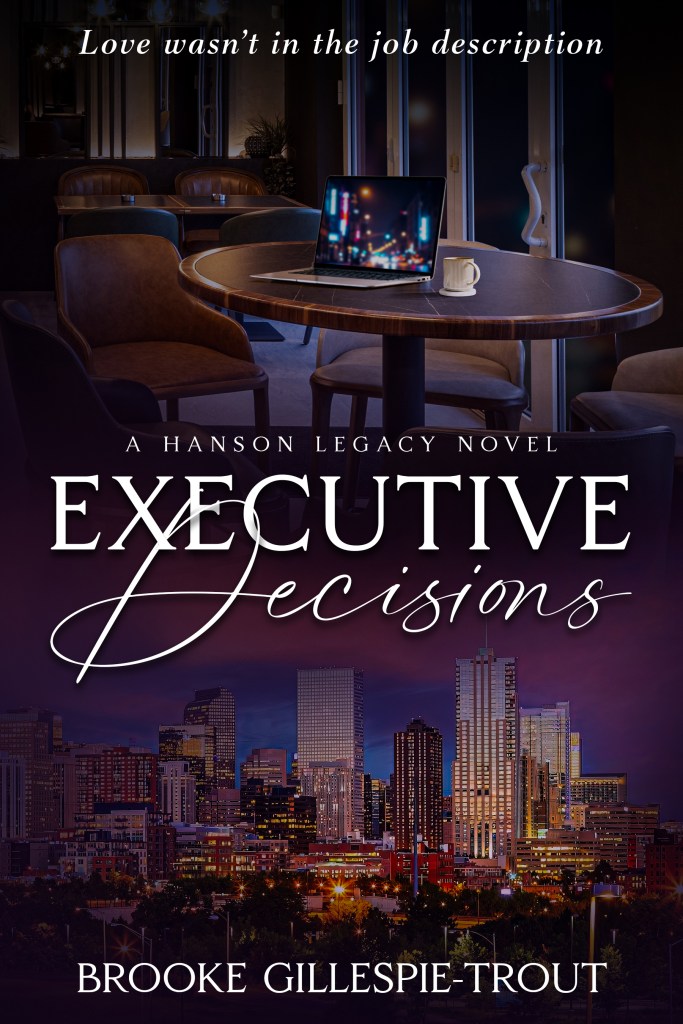
Brooke: I wanted the cover of Executive Decisions to visually represent the collision of two very different worlds. The top half of the cover is a nod to my protagonist, Lauren, and where her journey begins. She’s a blogger who spends her days working out of a local café, so the laptop and the coffee cup represent her world… her independence, her hustle, and the life she’s built for herself. It’s grounded and relatable, and the tagline ‘Love wasn’t in the job description’ hints at the unexpected shift her life is about to take. The bottom half features the glowing Denver skyline, specifically representing the high-end Cherry Creek area where the story is set. This symbolizes the Legacy side of the book… the sprawling, billionaire world of Drew Hanson. I chose this split design to show the contrast between Lauren’s cozy, everyday reality and the glittering, high-stakes atmosphere of the Hanson family. The sweeping script of the title bridges these two worlds, showing that while their backgrounds are worlds apart, their hearts are finding a common ground.
Helen: I love learning about the ideas behind the covers. The split images are so effective. How did you come up with the title?
Brooke: To be honest, I rarely have a title ready when I first start a book. I usually dive into the outlining process and let the characters tell me who they are first. The title for this one actually came to me while I was out taking a walk with my daughter. We were deep in conversation about the plot and the dynamics between Lauren and Drew, and out of nowhere, Executive Decisions just clicked.
That’s usually how it happens for me, the right title tends to find me when I’m away from my desk. For this story, the title felt perfect because it carries a double meaning. On the surface, it reflects the corporate world of the Hanson family and the professional choices Lauren has to make during her interviews. But on a deeper level, it’s about those pivotal, life-altering decisions we make for ourselves… the ones where we stop following a script and start deciding what kind of legacy we want to leave behind in our personal lives.
Helen: I end up dithering over titles. I brainstorm up a few ideas and then can’t decide between them. My newsletter subscribers have been very helpful choosing titles. Why did you choose to write this particular book?
Brooke: I always say that I don’t really ‘think up’ ideas, they find me. I wrote Executive Decisions because it was the one story that started playing like a movie in my head and wouldn’t stop!
It began as a small spark from my own life. Memories of a year where I went on fourteen interviews and blogged about the experience, but then my imagination took over. I started watching Lauren’s journey unfold.
When a story starts to marinate like that, I just have to follow it to see where it goes. I wrote it because I wanted to capture that specific cinematic energy and the mix of a grounded, relatable hustle with the fascinating world of a billionaire family. Once the movie in my head reached the final scene, I knew I had to get it down on paper.
Helen: Yes, I can sympathise. At some point you have to get it out of your head and on paper. When did you first realise you had a passion for writing?
Brooke: My passion for storytelling actually started on the stage. I began acting in community theater at age ten, which eventually led to years of work in local commercials and indie films. One of the most eye-opening moments for me was filming a national commercial for Chevy; seeing the jump from low-budget local sets to a massive, high-budget production gave me a deep appreciation for the machinery of a story.
Whenever I was acting, I found myself getting caught up in the dialogue. I’d start rewriting it in my head, daydreaming about the characters’ lives before the script started and after it ended. I actually attempted my first novel when I was 23, but life kept me busy for a while! I continued to play with stories over the years until everything finally clicked, and I published my first full novel at the age of 42. I think those decades of inhabiting different characters as an actress are exactly what allow me to watch my books like a movie before I write them.
Helen: That’s so great that acting led you naturally into storytelling. Was there anyone who first inspired you to write?
Brooke: My writing journey has been shaped by three icons who each brought something essential to my craft: Nora Roberts, LaVyrle Spencer, and Jackie Collins.
Nora Roberts taught me the power of world-building and dedication, while LaVyrle Spencer showed me the importance of deep, emotional vulnerability. She made me believe the heart of a story is the character’s internal evolution. And then there is Jackie Collins, who brought that unapologetic, high-stakes glamour and pace that keeps you turning pages.
In fact, my Heart & Soul series really showcases that Jackie Collins influence. It’s edgier, a bit bolder, and whenever I sit down to write those characters, my ‘inner Jackie’ absolutely comes out. Between the emotional depth of LaVyrle Spencer, the world-building of Nora Roberts, and the daring edge of Jackie Collins, I like to think my books are a unique blend of all three: grounded heart, high-stakes drama, and a whole lot of fire.
Helen: Who is your protagonist and why did you write her/him?
Brooke: My protagonist is Lauren Lane, a sharp-witted blogger and career-driven woman who isn’t afraid to ask for what she wants. I wrote her because I wanted a character who mirrored the modern, messy reality of the job hunt, and someone who is authentic, relatable, and determined to hold her own.
Helen: If your Main Character could answer, why would they say we should read your book?
Brooke: If you asked Lauren, she’d probably tell you: ‘Read it because you deserve to see what happens when someone decides they’re done being interviewed and starts taking control of their own life.’ She’s the voice for anyone who’s ever sat in a corporate office and thought, ‘There has to be more to the story than this.’
Helen: I think Lauren has the right idea. Executive Decisions is a contemporary romance, is that the genre you write in?
Brooke: I write contemporary romance because I’m drawn to stories where characters grow, overcome obstacles, and ultimately find that connection that makes everything else fall into place. Having spent years as an actress, I’ve always been fascinated by human dynamics, and for me, there is no better space than romance to explore the what ifs of life… like how professional ambition and personal heartstrings collide.
Helen: What is the best thing that has happened to you since you began writing?
Brooke: The best thing, without a doubt, has been the internal shift I experienced once I finally finished my first book at 42. It felt like I unlocked a door that had been waiting for me for decades. Before that, I think I was waiting for inspiration to strike, but once I proved to myself that I could sit down and execute a full story, my creativity didn’t just wake up, it started to overflow.
It’s been an incredible relief, too. Now, whenever I find myself starting to worry about where the next story will come from, I don’t panic anymore. I’ve learned to trust the process. Inspiration has this funny way of showing up right when I need it most, whether it’s during a walk with my daughter or a quiet moment in my day.
Helen: I started writing even later than you. I am what you call a late bloomer, but once I started writing, I couldn’t stop. I can’t imagine ever stopping. I love creating new characters and new worlds. I know this is a tough question, but who is your favourite character from your book?
Brooke: It’s honestly like choosing a favorite child, it feels impossible! I have a soft spot for at least one character in every book I’ve written. But if I have to pick one from Executive Decisions, it has to be my protagonist, Lauren Lane.
I love her spirit. She’s incredibly smart and has that grit that comes from real-world experience, but my favorite thing about her is how she handles herself when she’s pushed into a corner. She has this sharp, sassy wit that comes out the moment she feels threatened or challenged. I genuinely admire her strength, and writing her dialogue was some of the most fun I’ve had in a long time. She’s the kind of woman who refuses to be anything less than herself, no matter who is sitting across the desk from her.
Helen: Moving on to your writing process. Do you listen to music when you write?
Brooke: That’s a hard no from me! I find music to be a major distraction. Honestly, the movie playing in my head is loud enough on its own. I have enough voices to manage without adding a soundtrack to the mix! When I’m deep into a scene, the dialogue and the emotions between my characters are constantly running, and I need total quiet to hear them clearly. For me, the silence is where the story happens.
Helen: Have you ever suffered from writer’s block? If so, how do you overcome the fear and the little doubting voice in your head to keep writing?
Brooke: I think every writer deals with two things: actual writer’s block and the occasional lack of motivation. When I’m really struggling, I don’t try to force it. Instead, I set a timer for 15 minutes and I write with my eyes closed.
By removing the visual of the screen, I’m not distracted by the words already on the page or the temptation to backspace and edit. It allows me to truly see the movie playing in my head and get the story out unfiltered. Because I’m a fast typist… hitting over 75 words per minute… I can get a surprising amount of story down in those 15 minutes. Of course, this method does lead to some pretty amusing typos that I have to clean up later, but 99% of the time, that quick burst of blind writing is exactly what I need to push through the block and find my momentum again.
Helen: You are so lucky that you can touch type. I wouldn’t understand a word I typed, if I closed my eyes! What is the most useful piece of writing advice you’ve received, and by whom?
Brooke: I’m a big believer in the power of quotes to keep me focused, especially when the creative process gets a little overwhelming. There are three that I live by, and they’ve truly shaped how I approach my desk every day. The first is, ‘Comparison is the thief of joy.’ It’s so easy to look at other authors’ timelines or success stories and lose sight of your own path. Remembering that my journey is mine alone keeps me present and grateful.
The second, ‘You can edit a bad page, but you can’t edit a blank one,’ is my ultimate cure for writer’s block. It gives me the freedom to be imperfect. It reminds me that the goal of a first draft isn’t to be brilliant; it’s just to exist so that I have something to work with. And finally, ‘Trust the process.’ This one is my North Star. Writing isn’t linear. Some days the movie in my head is playing in high definition, and other days it’s static. They aren’t just quotes to me; they’re the tools that keep me writing.
Helen: That is some great advice. When you have time to read, do you have a favourite book?
Brooke: My favorite book of all time is Twice Loved by LaVyrle Spencer. I first picked it up when I was 15, and I’ve re-read it at least a dozen times since then. What’s so fascinating about reading it over the years is how my perspective shifts. The more I grow and experience life, the more I understand the characters’ choices and the nuance in how they handle their situation.
It’s actually quite funny because a love triangle is usually my least favorite trope, but LaVyrle Spencer handles Twice Loved with such incredible depth and heart that it somehow became my favorite book. It taught me that it’s not just the trope that matters, it’s how you write the characters caught inside it. It’s a masterclass in emotional storytelling, and it’s a book I’ll keep coming back to for the rest of my life.
Helen: We’ve nearly reached the end of the interview. Thank you so much for sharing your journey. Is there any advice you’d give new writers?
Brooke: My biggest piece of advice is simple but hard to do: Write for yourself. When you start worrying about whether a certain type of reader will like your story, you lose your voice. I love the phrase, ‘Dance like no one is watching,’ but for writers, I prefer to say, ‘Write like no one is reading.’ If you try to censor yourself while you’re creating, you’re never going to get to the truth of the story. Pour your heart out onto the page first. Be messy, be vulnerable, and be honest. You can always edit, revise, or refine those words later, but you can’t fix what isn’t there. When you stop writing to please an audience and start writing to satisfy your own curiosity, that’s when your unique voice finally comes through.
Helen: More great advice. Thank you so much for joining me today. It’s been great chatting with you and learning about your book. Good luck with your launch. Is there anything else you’d like to add to close us out?
Brooke: You know, looking back, the most unexpected part of this journey has been realizing that everything I’ve done… the acting, the commercials, the 14-interview year, and even the daily walks with my daughter… was just research for the books I’m writing now. I used to think my path was a bit winding, but it’s all fed into the stories. Whether I’m watching a scene play out in my head or just trying to navigate the messy, wonderful chaos of daily life, I’ve learned to trust that no experience is ever wasted. If you’re a reader or an aspiring writer, just keep living your life, keep your eyes open, and don’t worry if your path doesn’t look like everyone else’s. The story is in the living
About the Author – Brooke Gillespie-Trout
Brooke Gillespie-Trout is a contemporary romance author known for weaving together the drama of the stage with the irresistible pull of a “bad boy” charm. Drawing on her extensive background in theater and a life lived across the United States, Brooke crafts high-stakes adventures and deeply emotional love stories that keep readers turning pages.
With a dozen titles published, including the Heart & Soul series, the Portland, Maine trilogy, and the fan-favorite The Art of Zen, Brooke has established herself as a versatile voice in modern romance. Her stories are celebrated for their relatable characters, dramatic flair, and unforgettable “happily ever afters.”
Now residing in the Las Vegas area, Brooke continues to explore new adventures in print. Her latest work, Executive Decisions, marks the beginning of the Hanson Legacy series, a high-octane dive into billionaire romance and family secrets.
As an Amazon Associate I may benefit from purchases made using these links.
If you enjoy epic fantasy then check out my award winning Sentinal series, which is now complete. If you like fantasy books with a touch of romance then you will love my SoulMist series, start with SoulBreather. Prefer Dystopian Science Fantasy? Then try Harmony. Start the adventure and stay for the journey.
Sign up to my newsletter and download a free novella called Sentinals Stirring and get notified when my next books are published.
By clicking the sign up button above, you agree to share your email address with the site owner and the newsletter platform provider to receive marketing, updates, and other emails from the site owner. Use the unsubscribe link in those emails to opt out at any time.
By signing up to my newsletter, you agree to receive commercial information from Helen Garraway, located at 61 Bridge St, Kingston, Hertfordshire, UK (Data Administrator). You can withdraw your consent at any time. The data will be processed until the consent is withdrawn.
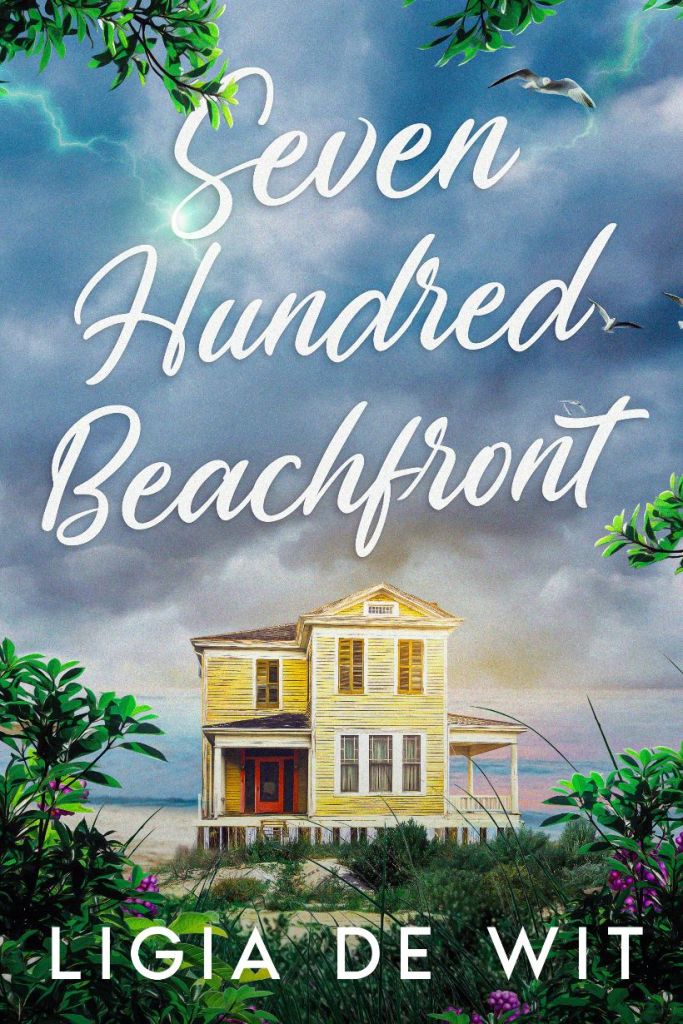
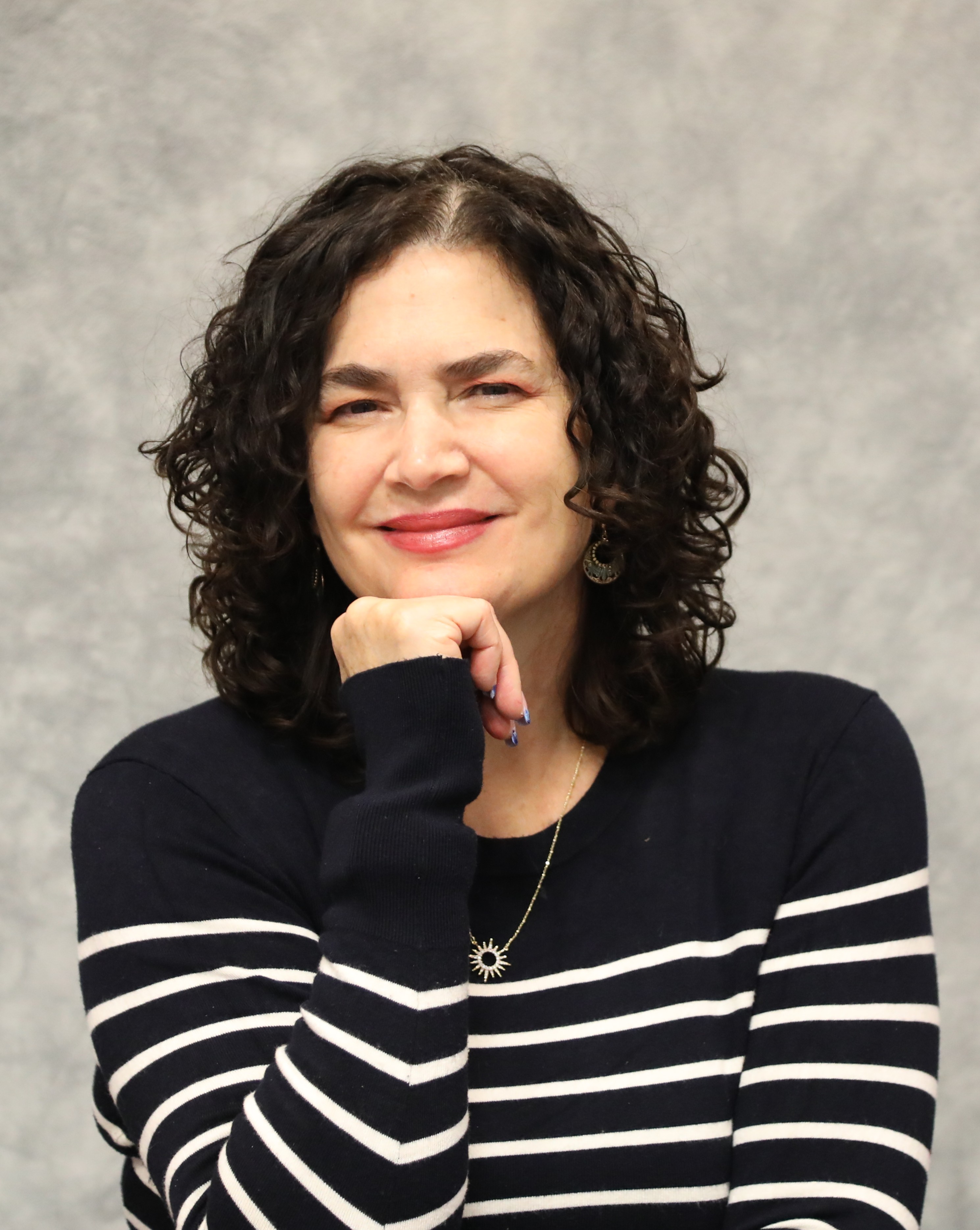
It’s time to meet author, Ligia de Wit and find out about her writing journey and her book Seven Hundred Beachfront.
Helen: Welcome, Saffron. It’s wonderful to have you on my blog. I’m looking forward to hearing more about what you’ve been working on since we last spoke. Tell is about your latest book.
Saffron: My most recently published book is Dripping Poison, book 3 in the Beyond The Veil Detectives series. It’s December 1929, and four young private investigators have been summoned by a dead man to a remote manor in the heart of the snow-blanketed English countryside. Before dinner, they’re forced to attend a seance that isn’t all it seems…And after dinner, someone is dead. Snowed in with a killer, the sleuths must now not only solve the mystery that brought them to Wilmott Manor, but they must now catch whoever is murdering his family one by one.
Helen: I love your characters, so I am sure this is amazing. What were your thoughts behind you cover?
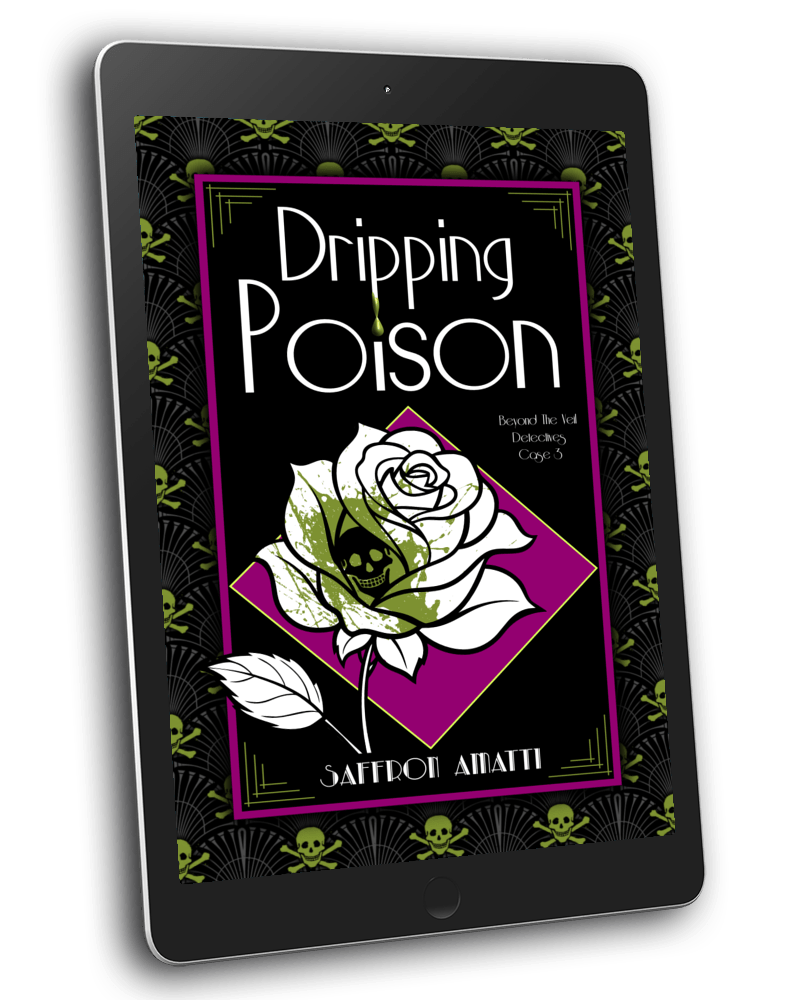
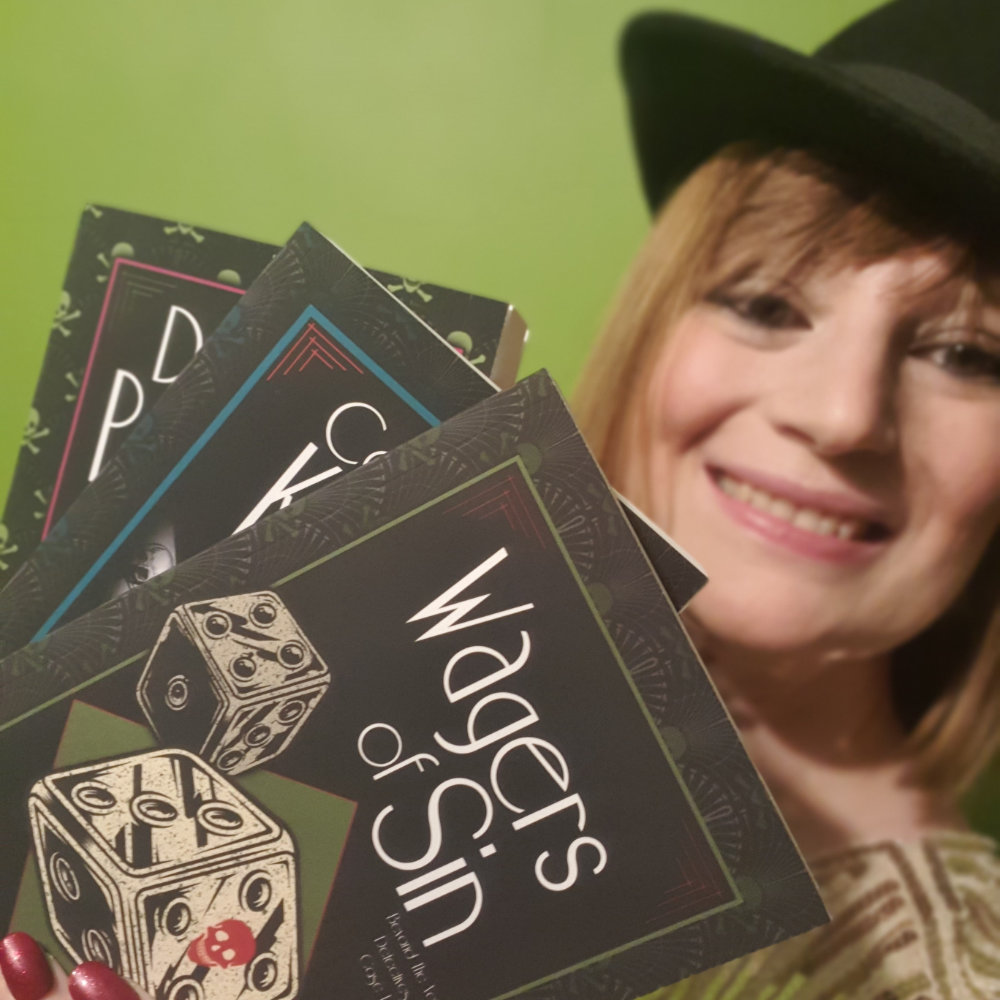
Saffron: So, I design all my covers myself (art classes finally coming in handy!) and I can probably go into far more detail than you could ever actually want. But essentially, I keep the same format across the covers for the series – the dark Art Deco-patterned background, the central image, the fonts and overall layout – to keep the covers cohesive. Then, I change the image (in this case, a rose) to something relevant to the story, and pick a bright contrasting accent colour. If I can squeeze a skull or a bloodstain or something similarly macabre in there too, so much the better! Anything to indicate it’s a murder mystery when someone is scrolling by.
Helen: You are so clever designing the covers yourself. How did you come up with the title?
Saffron: Dripping Poison is a book that was written for a title. Basically, I thought it sounded like a book title I’d pick up, and wrote something to fit!
Helen: It certainly sounds deadly! And suits your series. What made you write this particular book?
Saffron: Though the book could’ve gone in various directions, a major and perhaps unexpected theme is faking paranormal activity. Which wasn’t something I planned specifically for this book, but a few years ago, the local reader/writer group I’m part of asked me to write a murder mystery evening for our Christmas party. Me being me, I couldn’t resist putting ghosts in it – but I didn’t want it to relate to my books, so I created a fake seance (and slightly unnerved some of my fellow players because I didn’t write a script, just handed out character sheets and instructions to have fun improvising, and maaaaaybe accidentally-on-purpose didn’t tell everyone about the “ghosts” thing. Sorry, guys!) However, I loved the idea of dropping a real psychic medium (like my character, Lucas Rathbone) into a totally fake séance with lots of “paranormal” activity, and seeing what happened, so I found a place for it in Dripping Poison.
Helen: I always feel so sorry for Lucas. You are always dropping him into difficult situations! When did you first realise you had a passion for writing?
Saffron: Oh, gosh, I didn’t really. I sort of fell into it by accident. I basically thought of a story I wanted to read and wrote it, then wrote nothing for a couple of years until I thought of another story I wanted to read. Now I just keep on doing that, though I’m slightly more proactive about finding the stories nowadays!
Helen: Nice, that’s a very relaxed process. No pressure is good! Which element of the writing process do you find most challenging and why?
Saffron: Usually I’d say editing, but currently, I have an outline that’s refusing to be finished. I know what happens at the end of the book. I know whodunit, whydunnit, howdunnit, and all the red herrings and twists we’ll come across on the way to solving the murders. But the exact order of things is refusing to be pinned down.
Helen: Timelines can be the most challenging. The order in which things happen is really important and frustrating to get right! Talking about timelines, who first inspired you to write?
Um… whoever wrote the three or four really awful mysteries I read back-to-back before I decided enough was enough and I should write my own book?! Partially because I didn’t think it was altogether fair to criticise people’s efforts in something I’d never done, but mostly because I figured I couldn’t do any worse! I wouldn’t name and shame them, though, even if I could remember the books.
Helen: What a great reason to start writing. I’m so glad you did! Tell us about the genre write and why you chose it.
Saffron: I write historical murder mysteries with a paranormal twist. Or, paranormal mysteries set in the past, if you prefer. It’s been several years, and a dozen published books, and I still don’t know how best to describe them!
I grew up watching TV programs like Poirot, Midsomer Murders, and Jonathan Creek, so I guess murder mysteries are something I’m familiar with and felt like a natural fit. I’m also a bit of a history nerd, so again, it just felt natural to set my books in the past! Plus, the 1920s are a classic era for the kind of books I wanted to write.
As for having a psychic sleuth, I’ve been interested in the paranormal since I was a kid, and having a detective who could speak to the murder victims seemed interesting to me!
Helen: What is the best thing that has happened to you since you began writing?
Saffron: Finding a community of writers, especially on Instagram. Right from the start, they’ve been so welcoming, so generous, so supportive, and so all-round lovely. I’ve made real friendships, found help when I’ve needed it (and given help in return, which is truly an honour), and people who truly get how wonderful, frustrating, joyous, heart-wrenching, and magnificently challenging writing and publishing is.
Helen: The support of the writing community is so important to new writers, and the contined support is inspiring. What is one of the most useful resources you use when writing?
Saffron: I draft in an online writing program called 4 The Words, which has gamified writing sprints into an RPG where you battle monsters by writing a certain amount of words in a set time. Very useful for keeping scatterbrained people like me focused!
Helen: That sounds like so much fun and a great way to get words down on paper!! What a great resource to help people focus. How do you get the ideas for a new book?
Saffron: Generally, by stumbling across something interesting and idly wondering how it could be used to kill someone! I then figure out who would use something like that, who they would kill, why they’d kill that person in particular, and why the ghost wouldn’t just tell Lucas who killed them.
Helen: You always make it so difficult for Lucas. Lol! What are you doing to him next? Tell us about your current WIP.
Saffron: Hanged By Silk is the fourth book in the Beyond The Veil Detectives series, and much like the last one, is being written because I thought it was a good title for a book! (In case you’re wondering, apparently the English aristocracy could, if sentenced to hang, request a rope made from silk. This has no bearing on the story, though!)
It’s taking place in London just before Christmas 1929, and my team of four private investigators have split up to investigate two very different cases: one, the trade in fake antiquities, and the other, the murder of a young woman at a ritzy teetotal club.
Lucas, as the psychic medium on the team, thinks he ought to drop the antiquities case that’s boring him to tears and switch to the murder – but his wife and their friend Tommy want to prove their sleuthing prowess without supernatural help. So, Lucas is stuck on the deadly dull case with Tommy’s husband, Noah, and fretting about the woman he loves confronting dangerous killers, when…
When he steps into a junk shop and is overwhelmed with a feeling of dread, like something evil lurks in the shadows, watching him with curiosity, wondering what he is and how it can use him. He’s felt this once before, right at the start of the book, when a witch helping him understand his hated “Gift” hands him a necromancer’s notebook, and it makes his skin crawl.
Unwilling to let things that feel like… that stay out in the world where anyone could find them, Lucas and Noah start trying to find these objects. But when their investigation leads them back to the murder their spouses are untangling, perhaps it’s better the two groups join forces after all…
Helen: I know Lucas is your protagonist. Why did you write her/him?
Saffron: Lucas Rathbone arrived, unbidden and unnamed, in my head somewhere around the end of 2018, then spent six months nagging me to write his story. I do it mostly to shut him up, to be honest. No, I jest. Well, not entirely – the nagging really happened – however, I really just loved the idea of a psychic sleuth, particularly one who didn’t embrace their “Gift” but used it anyway, because it’s the right thing to do.
Helen: If Lucas could answer, why would he say we should read your book?
Saffron: “For the love of God, please don’t read it. I hate the attention, and Saffron only ever writes about the worst, most difficult parts of my life. She’s not as funny as she thinks she is, either.”
I’m so grateful for his help…
Helen: You guys have this love-hate relationship. It’s so funny to watch. Moving on to the business of writing. What is the most useful piece of writing advice you’ve received, and by whom?
Saffron: My friend, DP Haka, told me to make a cup of coffee and imagine sitting down with my character and talking to them as if they were someone I was meeting for the first time.
I fear this may have led Lucas to think he ought to be treated as an equal partner in this whole writing malarkey. However, as a comment I frequently get about Lucas is that he feels like an old friend, perhaps that’s a deal I can live with.
Helen: Every writer experiences self-doubt. How do you overcome the fear and the little doubting voice in your head to keep writing?
Saffron: So. The long answer is:
I’ve always been “arty”, and through school, college, and university, took whatever creative courses seemed fun. And anyone who says the creative arts are a “soft option” has clearly never been on one of these courses (at least, not with the lecturers I got), because every damn week you pour your heart and soul into something, only for someone to critique the living daylights out of it – sometimes in front of your peers – then tell you to go away and do it again for next week.
At which point, they’ll tear that apart, too. But if you want to pass your course – and I’m too stubborn to give in when I probably should – you must do it. If this sounds rough, it is. It destroys any confidence you ever had, but you have two options: either stay destroyed, or pick up your shattered ego and reform it into something new, preferably retrieving whatever gold may have been buried in the “constructive” criticism you’ve just endured.
It might take a lot of time and effort, it’ll never return to how it was before, and it’ll crack again with every harsh word you get about your work, but if you don’t pick yourself up again, that little creative spark, the thing that drove you to make something in the first place, will die forever. And whoever said you weren’t good enough will be right.
So, for me, that little voice in my head got bricked up behind the pieces of my broken heart a long, long time ago, and I can barely hear it any more. If I do, I tell it it’s wrong, because I win. They don’t.
The short answer is spite.
Helen: As a writer you have to accept that not everyone will like your work. It’s those that love it that you need to listen to. My reader’s support is what keeps me writing more. Let’s chat about your writing proocess. How do you fit your writing into your everyday life?
Saffron: I’m very lucky that I generally have a chunk of time every day to write in, so fitting it in isn’t much of a problem (having no kids, no social life, and no TV helps a lot!). But when I am too busy to get to the laptop and write for a decent amount of time, I have a Bluetooth keyboard that links to my phone. I can get set up to write in seconds, can put everything away again almost instantly, and write wherever I am.
Helen: Do you listen to music when you write, if so, what do you listen to and why?
Saffron: I listen to the soundtrack from the Monster Hunter World game, because it’s mostly epic orchestral music without lyrics. I’m also very familiar with it all, so it helps me block out the world/keeps my brain busy without being distractingly new!
Helen: As you write a period novel, how much research do you do for each book?
Saffron: As much as needs doing! Sometimes, if I’m pretty familiar with everything involved, it’s barely any – just a few things here and there to check I’ve remembered correctly. But other times, when I’ve had an idea and don’t reeeeally know how to implement it, research can take three times as long as writing. Usually, it’s somewhere in between.
Helen: Are you a pantser or a planner? Do you write free form, or do you have a framework you stick to?
Saffron: Kinda both. I do a lot of brainstorming for my books, and then once I think I know what’s going to happen, I’ll pants the outline. In fact, I usually pants it several times, getting in a horrible tangle along the way. However, I figure that, going back to the Terry Pratchett quote earlier, this is a quicker way of telling myself the story than trying to get the entire thing out of my head in something resembling a book. It’s also much quicker to add something to an outline than it is to a full draft. I’ve done that before, and these things have a habit of having knock-on effects throughout the book.
Once I’m happy with an outline, I’ll tidy it up into bullet points for each scene, which I stick pretty closely to.
Helen: Do you ever encounter writer’s block? If you do, what do you do to overcome it?
Saffron: Take a break. For me, it generally means something in a scene isn’t working, and I need to step back and do something else for a while. The problem usually works itself out whilst I’m not thinking about it, or I come back with a fresh set of eyes that can see where the issue is.
Helen: I agree, sometimes it’s better to just let the back brain noodle on it for a while, and then when you go to sleep, the answer comes to you. Or it does for me. Who is your favourite character from your book?
Saffron: Ooh, tough question! I love them all, but Tommy has the most interesting backstory, and honestly, he throws the most curveballs, as you’ll see later. Keeps things interesting… even if I sometimes wish he’d just finish a scene the way I planned it!
Helen: I think Tommy grew on everyone. If you didn’t write mystery then which genre would you like to try and write in next?
Saffron: Funny story, I nearly didn’t write mystery at all!
Before I started writing Lucas and co, I kicked around a couple of other ideas. One was a kid’s mystery series, another was a near-future sci-fi, but the one I actually started writing was a time travel alt-history set in WW2 Germany.
But there was too much research I didn’t want to do. Sci-fi isn’t a genre I’m super familiar with, certainly not the time travel subgenre, but I know the fanbase love their details to be precise. Similarly, WW2 German isn’t a period of history I know much about (I hate military history of any kind, but particularly the World Wars) but I can’t fudge details because there are plenty of people out there who love all that stuff and know every single tiny thing about the war.
Unfortunately, the story doesn’t work without time-travelling Nazis, so I ditched that and invented a cute village in 1920s England instead, so no one could tell me I’d got something wrong about a real place.
Then my characters ended up in London, but we won’t talk about that.
Helen: I’m so glad you ended up in the twenties! It would have been a great shame to have never met Lucas and the crew. Most authors read a lot. Do you have a favourite book? Tell us why you like it so much?
Saffron: Oh, this is a tough one. Currently, it’s probably – and please don’t take this as a recommendation to read it, because it isn’t – Brideshead Revisited, by Evelyn Waugh.
I actually picked it up as research and without knowing much about it, other than it was a (probably) semi-biographical book set in 1920s England with a bisexual male main character who has a same-sex relationship.
My character Tommy is a bisexual man living in 1920s England who is in a same-sex relationship, so I thought – brilliant. This is literally perfect for retroactively researching something I never planned for, because Tommy kinda neglected to mention he likes boys when he crash-landed in my first book, then took one look at Noah in book 6 and went “that one”, despite me having invented a nice girl for him to marry instead. This is what I meant earlier about curveballs, and this isn’t even the curviest one he’s thrown me.
Incidentally, I expected the same-sex romance in Brideshead Revisited to be more “read between the lines,” but nope. It was obvious Charles and Sebastian were a couple. What’s even more interesting is other characters clearly knew about their relationship too, but often seemed accepting of it. Totally unexpected, especially as the book was first published in 1945, a couple of decades before homosexuality was decriminalised in the UK. Anyway, I went into it expecting something fluffy and light-hearted about the upper classes. Kinda like Jeeves and Wooster, but a romance instead of a comedy. And for a good chunk of the book, it was charming, heart-warming romance, albeit with a dark undercurrent.
However, the reason I DON’T recommend Brideshead Revisited to just anyone is because it lures you in with this darling romance between two sweet young men, and – spoiler alert – then utterly destroys their lives. It’s beautifully written, completely compelling, bold, brave, unexpected, and absolutely something that SHOULD be read, but it’s still bleaker than a Bronte novel read in a leaky bus stop on a grey day in November when you’ve stepped in a puddle with leaky shoes.
Not something to be read if you’re feeling down, basically. And I think it’s important to point this out, because it completely floored me, and it’s fantastically written. But how I wish I’d known what I was getting myself into… Oh, heavy Catholic themes too, so if that’s a trigger for anyone, give this a wide berth. Anyway. My favourite book was heavier than I expected, and I loved it.
Helen: What are some of the books you read recently that you would recommend to others?
Saffron: I’ve just finished Guards! Guards! by Terry Pratchett, and had forgotten just how good it was.
I seem to be into re-reading at the moment, actually, as I’ve just re-read The Pale Horse by Agatha Christie, which again, very good. I’m a huge fan of the Jeeves and Wooster books, so always recommend those.
Not such recent reads, but Love Habit by TL Clark was one of my favourites from last year, and Raven Song by Jennifer Brasington-Crowley is excellent, and When We Were Out Of The Ordinary by Elen Chase is gorgeous. Having always said I hate romances, it’s quite surprising to find myself recommending three of them!
Helen: It’s been a pleasure chatting with you, Saffron. Thank you so much for sharing your journey. Just to close us out, what advice would you give new writers?
Saffron: Just do it. Don’t think too hard about it, don’t second-guess yourself, and don’t, whatever you do, edit as you go. Get everything out of your head, then come back to fix it later.
You’ll think it’s absolutely awful and want to consign it to the bin immediately – but remember every book you love has been edited a dozen times or more, and didn’t go to print the second the author wrote “the end.”
Your favourite author also looked at something resembling word salad, probably cried a bit, and then rolled up their sleeves to form the clay they’d just created into a beautiful object they were proud of.
There’s a quote from Terry Pratchett that says “The first draft is just you telling yourself the story,” and it really is. Once you know the story, you can refine it into something actually readable, but you can never get to that point unless you get that first draft out of your head.
About the Author – Saffron Amatti
Saffron Amatti is the author of the Lucas Rathbone Mysteries, a series of historical cozy mysteries with a ghostly twist set in 1920s England. She lives in a rather pretty village in Derbyshire, UK, where she spends an unhealthy amount of time thinking about how to kill people and (almost) get away with it. This is almost entirely in relation to her writing, but she keeps her family on their toes by throwing a little doubt in occasionally.
As an Amazon Associate I may benefit from purchases made using these links.
If you enjoy epic fantasy then check out my award winning Sentinal series, which is now complete. If you like fantasy books with a touch of romance then you will love my SoulMist series, start with SoulBreather. Prefer Dystopian Science Fantasy? Then try Harmony. Start the adventure and stay for the journey.
Sign up to my newsletter and download a free novella called Sentinals Stirring and get notified when my next books are published.
By clicking the sign up button above, you agree to share your email address with the site owner and the newsletter platform provider to receive marketing, updates, and other emails from the site owner. Use the unsubscribe link in those emails to opt out at any time.
By signing up to my newsletter, you agree to receive commercial information from Helen Garraway, located at 61 Bridge St, Kingston, Hertfordshire, UK (Data Administrator). You can withdraw your consent at any time. The data will be processed until the consent is withdrawn.
It’s time to meet author, Ligia de Wit and find out about her writing journey and her book Seven Hundred Beachfront.
Helen: Welcome, Ligia. It’s a pleasure to meet you. I’m really intersted to hear about your book, Seven Hundred Beachfront.
Ligia: Seven Hundred Beachfront is a contemporary magical realism story set on the beach. Because we all need some beach in our lives, don’t we? It follows a young woman who’s used to being alone and doing everything by herself. She believes she doesn’t need anyone, so she pushes people away. But life has a funny way of placing the right people in your path, even if they come in unexpected forms: a five-year-old kid, a grumpy neighbor, and a sentient house who is even grumpier. So, three grumpy souls and one beam of sunshine. At its core, the story is about abandonment. About forgiving those who don’t deserve it. About letting go of pain—the kind that lingers right behind you, even when you pretend not to see it. It’s also about love. Not just romantic love (though that’s there), but brotherly love and self-love. About giving yourself permission to face that darkness and decide enough is enough. To tell yourself you are worthy of love. And yes, there’s grumpiness. And laughter. And moments of levity that stretch like a tarp over heavier things. Because sometimes, that’s just how life works.
Helen: You had me at Sentinent house. I love inanimate objects having an opinion. What were your thoughts behind you cover?
Ligia: Setting can be a strong part of a story. In Seven Hundred Beachfront, it is the story. Most of it takes place inside a dilapidated house, so the house is integral to everything. Did I mention the house is sentient? It even has a name. I always knew I wanted the yellow house right at the front. It’s stormy because it reflects the pain and hardship. There are seagulls to echo the sound of the beach. And of course, a touch of green lightning—something that’s part of the story and hints at the magical realism woven throughout.
Helen: There is always more than meets the idea behind book cover designs. I love the attention to detail you had when designing this cover. What made you writte this particular book?
Ligia: This might be my most personal book, one that reflects part of the hurt I carried growing up. Bev, the FMC, embodies that in many ways. But it also offers hope. That no matter how dark your life might feel, no matter that some things may never be fixed, you can still make magic happen in your own life. I wrote this when I was just starting to write again after a 20+ year hiatus, at a time when I didn’t think I was good enough. And because of that, I wrote this story non-stop.
Helen: I’m glad you found your way backing to writing. For me it is a passion, I just love writing. Do you listen to music when you write, if so, what do you listen to and why?
Ligia: Music has always been part of my life, so yes—I listen to it when I write. But it’s a complement, a minor character, not the main one. It has to blend with my mood as I work. I usually go for a chill playlist, something that stays in the background and lets the story take center stage. Right now, as I’m working on a very important part of my WIP, I’ve been listening to Ludovico Einaudi.
Helen: I love Einaudi! I listen to a lot of classical music when I write. How do you get the ideas for a new book?
Ligia: Great question! I pull them from the air, mold them with sand, and infuse them with a little pixie dust—and voilà, a book. Okay, kidding… but not really. It can feel that way. I get inspired by movies or books that move me deeply, and my brain immediately starts chanting what if… That’s usually where it begins but it’s only a small piece of it. I dream stories while I’m awake. They come to me (hence the “pulling them from the air”), and I shape them until I have no choice but to pour them onto the keyboard. The real spark happens then. I usually don’t have much at the start, but as I write, the scenes unfold, the characters come alive with vivid clarity: their struggles, their passions…And I get so excited I can’t stop typing. It’s beautiful.
Helen: I think ‘what if’ are two of the most important words for writers. If we didn’t ask these questions our stories would never happen. What are you working on now?
Ligia: Redemption of Faete is book four—and the final installment—in my Bradaís Pledge series. It’s a contemporary-to–second-world adventure filled with danger, immortal pirates (definitely not your typical ones), fae mentors shaped more in the Tolkien vein, and a human who begins the series naïve and a bit immature (lovely so—I’m in my 50s and still immature in some areas, so I wanted to represent that!). What I love most about this series is how both main characters grow—the immortal pirate and the young seer—and how the stakes rise with each book. This final installment is intense. It’s the end, after all. There’s found family, love lost (and found again; this is a HEA series), dragons meddling, and powerful gods trying to destroy their reality. It’s absolute chaos. Wonderful chaos.I’m currently in the middle of a major revision after receiving developmental edits, and it’s been so exciting to create new scenes and find even more ways for my heroes to complicate their lives.
Helen: Oh that sounds wonderful, chaos and dragons, what more can you ask for? Tell us a little about the protagonist in your story.
Ligia: This is a dual-POV series. I first wrote it from Ryanne’s perspective. Unlike many heroines, she starts with no real power—just some silly visions. At the beginning of book one, she’s a bit absorbed in her own world and hasn’t quite realized what it means to have a fae mentor and a brave pixie as her guardian. I wrote her because she—and the pixie—came to me one Sunday morning at 6 a.m. and demanded I write her story. I swear it’s true. I relented at 7 a.m. and wrote her first chapter, where she told me everything. I fell in love with her silliness (I’m pretty goofy too) and her personality. Then came Titus—a bloodthirsty pirate who can’t find peace because he’s controlled by his creator. Oh man, do I love Titus. It’s been an absolute pleasure to be in his head and watch his growth, especially in this last book. Why did I write him? In my first draft, he went out for coffee while Ryanne was trying to avoid the pixie—and drink far too much coffee (he’s addicted). I saw him there—worried, determined—and I knew I needed to understand him better. His story flowed from my fingers so easily.
Helen: What is the best thing that has happened to you since you began writing?
Ligia: Readers. Hands down. When I first started writing, I did it simply because I couldn’t stop (I have several drafts from that time that will never see the light of day as proof!). I loved creating stories, building worlds, and bringing characters to life. But then those characters made their way out into the world. Readers found them—and fell in love with them and their stories. And honestly, that’s more than enough reason to keep going.
Helen: I’m glad enthusiatic readers found your books. Thank you so much for joining me today. It’s been great learning more about your books. Most authors are also great readers. Just to close us out do you have any book recommendations for us?
Ligia: Reading is part of the writing life. Honestly, like most people, it’s been part of mine since I was seven years old. I can’t imagine a life without reading (please tell me heaven has a library… I need that). For epic fantasy, I’d recommend Khyven the Unkillable by Todd Fahnestock. It’s book one in a five-book series, and I recently finished the final installment—which is actually influencing the writing of my own last book. For a debut author—also epic fantasy, with wolves (not fantasy romance, very important!)—A Bird Among Wolves by Tracy Leonard Nakatani. Amazing. And for fantasy romance: Soulfire Blue by Jesse Sprague. It’s currently on Kickstarter as a gorgeous special edition, with art illustrated by the author herself.
Helen: Oh these sound really interesting. More for the TBR pile! Thank you for sharing.
About the Author – Ligia de Wit
Ligia de Wit writes fantasy romance adventures with heart, humor, and just the right dose of magic. A lifelong romantic with a soft spot for fairy tales and found family tropes, Ligia writes characters who are strong in more than just a physical sense. Her characters face fears, fight for themselves, and find love in the most unexpected places.
When she’s not writing (or rewriting) her imaginary worlds, she works for a global distribution company and dreams up stories during lunch breaks. You’ll often find her with her nose in a book, exploring a new city, hiking through forests, or acting like a total goof at theme parks. She’s a proud kid at heart—and owns it.
As an Amazon Associate I may benefit from purchases made using these links.
If you enjoy epic fantasy then check out my award winning Sentinal series, which is now complete. If you like fantasy books with a touch of romance then you will love my SoulMist series, start with SoulBreather. Prefer Dystopian Science Fantasy? Then try Harmony. Start the adventure and stay for the journey.
Sign up to my newsletter and download a free novella called Sentinals Stirring and get notified when my next books are published.
By clicking the sign up button above, you agree to share your email address with the site owner and the newsletter platform provider to receive marketing, updates, and other emails from the site owner. Use the unsubscribe link in those emails to opt out at any time.
By signing up to my newsletter, you agree to receive commercial information from Helen Garraway, located at 61 Bridge St, Kingston, Hertfordshire, UK (Data Administrator). You can withdraw your consent at any time. The data will be processed until the consent is withdrawn.
It’s time to meet YA Fantasy author, Suzanne Furness and find out about her books.
Helen: Welcome, Suzanne. It’s a pleasure to meet you. Tell us about your latest book.
Suzanne: Storm of Clocks is a middle grade fantasy set on the stunning North Cornish Coast around Tintagel Castle.
It is perfect for readers of 8 and upwards. I know of at least one 96-year-old lady who loved it!
Eleven-year-old Livvy’s life is torn apart the night her dad dies in an accident and her brother stops talking. A tiny piskie with BIG secrets bursts into her world warning a storm will cause massive destruction to her town. However, the storm could reverse an ancient curse that will herald the return of giants. Livvy must follow her new piskie friend, Patsy, into a hidden world of folklore and legend to discover dangerous creatures lurking in the bushes and magical birds that soar overhead. It’s a story of loss, friendship and hope.
The clocks are ticking . . . The skies are darkening . . . The storm is approaching . . .
Storm of Clocks was short listed in 2025 for the Holyer an Gof Award. An annual award for the best books promoting Cornwall, set in Cornwall or written in the Cornish language.
Helen: Such a beautiful coastline. With all the myths and legends in Cornwall, I bet you had great fun writing this book. What were your thoughts behind you cover?
Suzanne: I simply LOVE this cover. Big thanks to my fabulous illustrator, Alexandra Fowler. Alex and I were able to meet up and discuss my vision as she lives very close to me in Cornwall. I wanted to have Livvy and Patsy (the piskie) standing on the cliff top as the storm began. The lighthouse was Alex’s idea as we thought it would add a highlight. I think it works really well with the waves crashing over it. I then suggested the lightning streaks which Alex was able to incorporate into the title. The frame of the cover is a tree which features in the story (no spoilers here you will have to read the book!). Alex has cleverly hidden other clues to things in the story amongst the tree and other plants. Look closely for a pocket watch, a book, and the birds. Flip the book over to find a deer and a pair of eyes lurking in the bushes!
Helen: There so much detail in your cover, I love learning what all the images mean! I assume Livvy is on the cover, tell us more about her.
Suzanne: The main protagonist is an eleven-year-old girl called, Livvy. Short for Olivia. We learn she lost her father in a car accident which resulted in her younger brother, Ed stopping talking. Obviously a very tricky time for Livvy. The story is set several months after the accident as Livvy is learning to manage some of her feelings. Then she finds Patsy Scribble a Cornish Piskie in the compost heap and her life changes again. Livvy grows through the story and starts to see that her life can move forward but she can still keep a piece of her dad in her heart. This might seem a sad story but in fact it is uplifting and contains lots of hope. It’s an adventure that changes her forever.
I experienced the loss of my dad at a young age too. Different circumstances but the feelings and heartbreak were the same. I hope some of that first-hand knowledge comes through in the story. I started writing Livvy’s story shortly after my mum died after a long illness 13 years ago. I think it was cathartic in many ways. The image of meeting a piskie at the bottom of the garden was very strong and the story grew from there. It’s been through lots of editing and rewrites to get it to where it is.
Helen: I also found writing cathartic. I started writing after my mum passed away. Much later in life, but the time was obviously right. My greatest regret is that she never got to read any of my books. Is Livvy your favourite character or is there anyone else you found interesting to write?
Suzanne: Hmm, this is an interesting question because as I have explained above, Livvy is a special character to me. However, I love the feisty piskie, Patsy Scribble. She is definitely not a stereotypical piskie. (In case anyone was wondering a piskie is a Cornish word for a type of pixie.) She comes out with some funny sayings and quite often is a little rude about humans and their world.
There are also three birds in the story. One is the very clever and slightly superior Cornish Chough called Merlin. (Yes, it is an Arthurian reference). He was fun to write too. He doesn’t speak as such but he I tried to portray his character through his behaviour and actions.
Helen: Your characters sound like fun. When did you realise you had a passion for writing?
Suzanne: I think it’s always been there but maybe I didn’t fully understand it till a lot later on. As a teenager I wrote lots of poetry, which was one of the ways I tried to cope with the loss of my dad and other life events. It was years later that I actually started to think about writing a story. My first attempts were short stories for adults. I entered a few into competitions. One even got published in an anthology. I then tried writing an adult novel. Looking back, I can fully see it wasn’t great but I learnt a lot from those 80K words! I moved onto writing for children shortly after that. I have worked with children for many years as well as bringing up two of my own so it seemed a natural progression for me.
Helen: I think the more you write, the more you practice, the better you get! If you don’t write then there’s nothing to edit or improve. When writing, do you plan in advance or make it up as you go?
Suzanne: I have to admit I am a pantser through and through! It’s a slightly strange concept for me as in most areas of my life I plan things carefully and I am not a person who enjoys chaos or just going with the flow. Perhaps that’s exactly why I have to let my creative juices do their own thing when writing. I usually start either with a line of writing or a character name and go from there. I might do mind maps and character description cards as I get into the story a bit but other than that it’s just open the laptop and see what happens! Not the most efficient way as it means lots of editing and rewriting but so far it has worked for me.
Helen: I think what works for you is best. Do you find you need to do much research for your books?
Suzanne: Ah, well this is where I might spend a bit of planning time and like many writers, sometimes I find myself down the proverbial rabbit hole of research! But I do enjoy that side of things. With Storm of Clocks I researched Cornish folklore in depth and decided which aspects I could incorporate into the story. Quite often the research helped move the story forward when I got a bit stuck. It was fun to see how lots of things entwined. It’s such a big part of this story I have added a glossary at the back to explain a few things a little more. I have sprinkled the story with a few Cornish words and phrases too which all add to the feel of the book.
Helen: Writers tend to end up knowing so much trivia! What else are you working on?
Suzanne: I have a fun and slightly quirky story about a young boy, Jack Potts, who finds a door at the back of his shed which leads to a world known as Underbed Storage! A place where rubbish is treasure and nothing is wasted. He meets a clumsy dragon, a sort of wizard and some rather strange robots. It’s a very different story to Storm of Clocks but The Accidental Adventures of Jack Potts is a fun adventure for readers 7 plus. It’s got lots of fun illustrations too so is ideal for the more reluctant reader or new to chapter book readers. Check out Ink Bookshop or Amazon
I am hoping to be able to share news very soon about a new middle grade story that will hopefully be published later this year. Watch this space or follow my socials for the latest information on that exciting project.
Helen: Thank you so much for joining me today. It’s been great learning more about your books. Is there anything else you’d like to share?
Suzanne: My website is here and I’m always happy to chat so give me a follow or get in touch. I can sell signed books direct and will include bookmarks and stickers so if that is something you would be interested in just get in touch to arrange.
About the Author – Suzanne Furness
Suzanne lives in Cornwall with her husband and a cat with a moustache! She can often be found walking the coastal footpath on the lookout for pirate ships and lost mermaids or exploring woodlands and moors on the hunt for fae. Sadly, she hasn’t found a piskie at the bottom of the garden but she will never stop looking.
As an Amazon Associate I may benefit from purchases made using these links.
If you enjoy epic fantasy then check out my award winning Sentinal series, which is now complete. If you like fantasy books with a touch of romance then you will love my SoulMist series, start with SoulBreather. Prefer Dystopian Science Fantasy? Then try Harmony. Start the adventure and stay for the journey.
Sign up to my newsletter and download a free novella called Sentinals Stirring and get notified when my next books are published.
By clicking the sign up button above, you agree to share your email address with the site owner and the newsletter platform provider to receive marketing, updates, and other emails from the site owner. Use the unsubscribe link in those emails to opt out at any time.
By signing up to my newsletter, you agree to receive commercial information from Helen Garraway, located at 61 Bridge St, Kingston, Hertfordshire, UK (Data Administrator). You can withdraw your consent at any time. The data will be processed until the consent is withdrawn.
It’s time to meet Author and poet, Ectorius Angel, and find out more his writing journey.
Helen: Welcome, Ectorius. It’s a pleasure to meet you. Tell us about your work.
Ectorius: People keep asking me about a book. I have tried so hard to be honest and say that I do have one, and I do, but it’s one that can’t be published any time soon, in the hands of a lovely publisher called Curious Corvid Publishing. It’s called The Flowers of Hades, and it’s perhaps the roughest, but somewhat also more original works I’ve ever written. I wish I could tell you more about it, let you know what else there is to say, but right now, all I can really say is that it will come when it is time. I wish I could say a lot more about it and my second book, called Remember We Once Lived. A story about Alexander the Great and Hephaestion. That is the most heartfelt, poetic, and truly hardest work I’ve ever written in my entire life. I have cemented over five years of research and archeology, academic research and historical research just to have the general knowledge and understanding of Hephaestion’s and Alexander’s inner lives. These are in the hands of Ravven White of Curious Corvid Publishing right now. However, more than anything, I’m a poet, and I guess, in some way, instead of a current book, I’d of loved to say that I have many poems coming, because there have been quite a lot that has been sent in to poetry journals, magazines, art centers, and so much more. That is my biggest pride to announce, more than any other book. I come from poetry, and poetry is what made me.
Helen: Congratulations on your forthcoming publications, and I bet the waiting for your books to come out is excrutiating. Have you had sight of the covers yet?
Ectorius: I’m sad I can’t really say much here. Covers are something I believe come at the end, once the book has been made ready for publishing. Right now, I don’t really know what it would be like, or what its design will look like just on principle. We have great designers in Curios Corvid, and many others in other publishers and whatnot. So, hopefully, it will be beautiful, and I think simplistic, because that’s what I would like to be.
Helen: How did you come up with the title for your book?
Ectorius:The Flowers of Hades wasn’t its original name. In reality, it was very far from that name. There are characters based off of a lot of other people, but two female characters are based majorly around the bad and the good parts of my partner, Finian, who has been by my side for years. Originally, it was named something entirely different. It had…Four titles, before settling on that. Titles are…They are the body of my work. I know how stories will end, I know how tragedy will come and what I need to suffer through to write it. I never plan, I hate planning, I find it absurd and it makes no sense in any capacity. You write to feel something; you write because you feel.
Helen: I think everyone has a different way of writing and as long as you continue to love what you do, and you enjoy writing then that is what works for you. What made you write this particular book?
Ectorius: I want you to imagine walking into a bedroom; it belongs to someone you once loved, or knew, or someone you hated. But it still belongs, regardless, to someone. There are books there, clothes, items, things you don’t know much about. It’s the inner life of someone else. Someone you’ll never get to see, and however you feel, never get to resolve anything with. How you feel is up to you, and it’s for nobody to shame. And you stand there, looking, alone, not a word to your mouth, a smile to your face. Just a torn, empty self that can only be ready to get rid of everything to never feel it again. A hatred or a desire to get rid of something so strong. It’s how ordinary people or ordinary writers will never understand why I prefer solitude, why love doesn’t kill loneliness, or the suffocation I feel every day when someone mentions the name of a person I know, or when they tell me “Why can’t you do something so simple?” When my mind is constantly busy, and I easily lose track of things. I’m never there, even in the most important moments; I’m always unreachable. I guess that’s why I wrote the book, why I write anything at all. I can’t live without writing, and I can’t write without suffering living. Every day is a constant wish for an eternal rest without the call of writing in a modern age, but I know that if I stop even once, I’ll want to kill myself here and now, and that is the worst and best thing I have ever been able to say about why I write anything.
Helen: Creating a work of art can be consuming. As always, balance is important. Life feeds creativity and creativity feeds life. If you don’t experience one, how can the other exist? When did you first realise you had such a passion for writing?
Ectorius: I never really realized it. I was too young to really understand. I knew that some days I’d walk outside in Italy or Germany and I’d just stop. There’d be a bird, or a hawk or a butterfly or even just the light off of the edge of a ledge of another building. The sunlight, the grass, a sway of blades that feels like a caress. I guess to answer the “When” of it, it’d be earlier than I can really remember. So early it just came to me, and by nine, I had a mentor who was a published author of whom I studied under.
Helen: On your writing journey was there anyone who gave you the inspiration to write?
Ectorius: That’d be my mentor, Jules, and my friends. Ana Monica Banto, Dr. Catherine Sooyun Lee, Iselin Lørentsen, Stefani Stamboliyska-Murffit, Joshua Sell, and James Johnston and Patrick Walsh, now known as Vox Forged as a voice actor. Without them, I wouldn’t really be here. But more than anyone else, it is also Finian Sun, my partner, to whom I owe everything, now and any time in the future.
Helen: I know you write poetry, but for fiction, which genre do you typically write?
Ectorius: Romance, historical romance, romantic poetry, travel poetry and in general just contemporary romance. Much of it is to do with the fragility of life. How a shadow falls on a wall and we look at it, quietly, unmoving. How the touch of a hand says you are safe. Or even how an old motorbike leaning against a wall can be the last drop of a memory that you never want to let go of. Human sensuality, gentleness, fragility, the seconds of quietness between moments. And especially the fractured parts that show our most vulnerable selves.
Helen: Who is your protagonist and why did you write her/him?
Ectorius: He is David, a boy who isn’t quite understood by others, or by those around him. He’s an outsider, a travelling nomad, someone who can’t quite be the thing everyone wants. Having lost a lot, seen more funerals than I can really count on two hands at the age of twenty-seven, it… It makes you look on a lot. On those you’ve lost, the people you’ve remembered, the smiles, everything else. That led to this. Writing about seeing the world from a writer’s perspective, but hurtful, emotional, raw. So raw that even my own lecturer had to email me and ask me if I was alright haha.
Helen: If your Main Character could answer, why would they say we should read your book?
Ectorius: I think the main character wouldn’t want anyone to read his book. It’s a diary entry of every day life, of existing. One could even say it’s the deepest and most vulnerable emotions out there, and that alone would make him scared of anyone ever really reading it.
Helen: How do you get the ideas for a new book?
Ectorius: Some days I will look at something and eventually that little something turns into more. The flicker of a light at a traffic stops during the rain in Tokyo, or the calm walk through Roma as you see tourists and the shadows that linger just a little over the ancient ruins. There’s a story in everything, every part of life, and in some manner, it just comes by itself. I believe the stories that need to be written, come to their own designated writer, their own storyteller. A small spark of a flame that gently carries its heat onward until it reaches the wandering one.
Helen: Are you working on anything new? Could you tell us about your current WIP.
Ectorius: I am currently working on publishing three poetry collections when and if I can, and a non-fiction work that I’ve started with my undergraduate. It was originally written as a study paper of sorts for writing purposes. Now it’s a more truthful and vulnerable piece. An exploration of a person’s inner life, the dreamscape of it all, the bond between reality and surrealism. It’s a work very much like Murakami’s.
Ectorius has had poems published in Era Lit Magazine. You can read the poems here.
Helen: Which element of the writing process do you find most challenging and why?
Ectorius: I’d say editing, but having been an editor, now it’s more or less quite facilitated. If anything, telling the truth in writing. The way of being vulnerable and open, and honest to the point of feeling hurt by it. There’s a harshness in writing truthfully, and it requires you to be hurting, the kind of pain that you can’t just accept and walk away from. Had it not been for that, I don’t know what I’d do.
Helen: What is one of the most useful resources you use when writing?
Ectorius: I do not really utilize resources. I have a pen, a notebook, and a paper. That’s it. Everything else is purely writing, as it always has been.
Helen: What is the most useful piece of writing advice you’ve received, and by whom?
Etorius: “Write truthfully” by Judith Heneghan, my lecturer. And “Ordinary people and their opinions don’t matter. They’re nothing. Stories, stories are everything. Write them, because you’re one of the few that are born with it. You have a duty, and that duty is solely yours.” by a very close friend and author. These two are the most important parts for me. And I think they always will be.
Helen: Every writer experiences self-doubt. How do you overcome the fear and the little voice in your head to keep writing?
Ectorius: I spent at least twenty minutes to think about how to answer this. Truthfully? I don’t really have any doubts. I never really did. I wish I did, and I wish there were ways for me to say so, but I don’t. I write because I know what I am, and that alone makes me not need doubts. It never really did.
Helen: How do you fit your writing into your everyday life?
Ectorius: Everything I do is writing. My partner would tell you so, even my friends, even the people who truly know me. I could be conversing with someone, and in the end, I’m not even thinking about them or the conversation, but the dust on their jacket or the light of the window, a bird on a tree branch. I’m never there, even on the most important days, like a date. There have been times where my beloved has caught me just looking at buildings, windows, the sea, and anything else in-between. Sound comes and goes, and I remember what’s said, but I can’t quite say I’m ever really there. Every action, just like breathing, is writing. What I see, sense, feel, touch, eat, endure, or otherwise simply have any form of sensory contact with in any capacity, becomes writing.
Helen: Do you listen to music when you write, if so, what do you listen to and why?
Ectorius: I do, and I don’t. Some days I need silence, loneliness, and other days I need music. I listen to Kensuke Ushio, Ryuichi Sakamoto, Kenichiro Suehiro, Masaru Yokoyama, Ichiro Araki, Takeshi Obo, Konomi Suzuki, Kanzaki Iori, and Haruka Nakamura. There’s even a playlist called Orchestra Et Sum, a collection of every orchestra, instrumental or otherwise sentimental based pieces I’ve listened to and like and that are part of my inner life. It’s a 57 some hour playlist on Spotify haha. I listen to them because I need time alone, I need to be able to process what I feel, how, why. And I need… A space to be quietly vulnerable without anyone and anything around. Music and silence do that. Especially the artists and playlist I’ve mentioned.
Helen: How much research do you do for each book?
Ectorius: Hephaestion’s and Alexander’s story took me five years of research before writing, because they’re historical people. Generally, I will dedicate a lot of time to research if it’s realism. But if it’s not, not a lot. I just write what I remember and experience.
Helen: From a writing perspective, are you a pantser or a planner? Do you write free form, or do you have a framework you stick to?
Ectorius: I already know the entire story just by the title alone. Titles, for me, are everything. They’re the se piece, the dressing room, the lighting and sound design. They’re every part of it. Most readers won’t really get it and they’ll sort of skip away from the title and into the nitty gritty of things, but I base everything around a feeling and a title. Especially because I already know how it will end. It’s like a surge, where an entire 500 some pages of a story come into your mind, bombarding you, trying to kill you if you don’t write it. I’m a hostage to my own work.
Helen: It sounds like you are typically quite prolific, but have you ever encountered writer’s block? Do you have any advice to overcome it?
Ectorius: I’ll be as frankly honest as I can here: I suffer. I harm myself with alcohol and isolation, and sometimes I don’t even do anything good for myself at all. Not being able to write is insanity for me. It kills me, slowly, until I’m at its mercy. It’s only been in the last two years that I’ve learned to deal with it differently. Finian usually sees when I’m struggling and ends up making us have a vacation or something else. I love her, because she knows what I need, and I don’t quite know how to explain that to anyone. It used to be worse; I used to spiral into the worst depths of darkness out there when I was far younger. Monica pulled me out of that, so did Ms. Catherine Lee. And James Johnston. There have been many times where not being able to write was a true danger to myself and nothing but an endless cycle of suffering.
Helen: Do you have a burning desire to write in a different genre? If so, what would you write?
Ectorius: If I didn’t write in romance, I… I would probably write in something that has a close proximity to the stylistics of Film Noir.
Helen: What is the best thing that has happened to you since you began writing?
Ectorius: I became a published poet. I got to see the world, learn about its beauty and underlying parts. I got to love, be loved, and experienced hatred, wrath, and every other emotion out there. I guess what I’m trying to say is: I got to truly experience life in the most wonderful manner, so much so that I am never quite sure if I ever walked out of the dreamscape.
Helen: What is your favourite book and why do you like it so much?
Ectorius: Savannah Brown’s “Sweetdark” and “In Praise of Shadows” by Jun’Ichirō Tanizaki. Poetry for me is important; it’s the root of where I started, and you could say the same for Savannah Brown, too. It’s where she started as well. I never got to meet her and such, but I figure we’d both understand each other if we ever did. And In Praise of Shadows by Tanizaki would probably be something that taught me a lot about how to utilize silence, light, architecture. Especially how important this aesthetic really is. In the west, they don’t understand it. I’m Lithuanian by birth and even I cannot really lean toward western ideals anymore. It’s too barbaric, too rough. And I guess my third favorite, or most liked book, not quite the word “favorite” for any of these… Would be “No Longer Human” by Osamu Dazai. It’s the most self-inflicted vulnerability out there, and if anything, the most raw example of writing truthfully no matter how badly it hurts.
Helen: I know authors are great readers. What are some of the books you read recently that you would recommend to others?
Ectorius: I… Would recommend philosophy. Especially Aristoteles’ work, Franz Kafka, or even the ancient greats and the philosophers of our time. Kant, too. Schopenhauer. I think discipline, philosophy, linguistics, the humanities, history, archeology, sociology, anthropology, the fine arts, literature, poetry. These are the most important foundations for anyone. I can’t recommend just “one” book so to speak. If anything, I would highly recommend discovering the world through philosophy and the classics, because I did, and I think everyone else should too.
Helen: We nearly at the end of the interview. Thank you for sharing your passion for writing. Is there anything anecdotal you’d like share.
Ectorius: When I first moved elsewhere, I got lost trying to understand the language. I asked five different people about how to say thank you and I’m sorry. An hour later, I discovered I didn’t really need it, because I was a stranger anyway. So I asked a neighbour what to do, and she laughed and simply gave me food. That’s how I learned that it’s not about communication, but that kindness had been right there in front of me, and I was asking how to ask for it, instead of accepting what I had.
Helen: Thank you so much for joining me today. It has been really interesting chatting with you, and I wish you success with all your endeavours. Just to close us out, what advice would you give new writers?
Ectorius: Write what you want, in the end, once you’re 20 or 30, only really some classmates and strangers can judge you. Nobody else. Your story is yours, and so are your feelings, and nobody has the right to shame that. Now or later. If you’re born as a poet or an artist, you have a sole duty of carrying on the legacy of art; that is the only thing that will and should ever matter to you. Nothing and nobody else is above your destiny.
About the Author – Ectorius Angel
Ectorius Angel is a Lithuanian poet and classical author whose work weaves themes of displacement, impermanence, and the unsaid moments that shape human experience. Raised across Europe and now residing in Norway and Hong Kong, he draws from influences spanning Eastern traditions to Western romanticism.
His writing reflects a deep appreciation for minimalism, resonating with the balance of light and sound, often evoking nature’s shifting seasons. Through vivid imagery, Angel conjures tidal waves and gentle landscapes, using water and rain as metaphors for emotion and capturing beauty in fleeting moments. This connection to nature underlines his explorations of nostalgia, loss, and the sense of being a ghost—an observer in a distant world.
Mentored by an Australian historical author, Angel’s literary journey centers on the complexities of human existence. He delves into the brokenness of heroes and the disillusionment that accompanies admiration, prompting readers to reflect on life’s fragility and intricate relationships.
Inspired by luminaries like Osamu Dazai, Haruki Murakami, and Yukio Mishima, along with Western influences like F. Scott Fitzgerald and Oscar Wilde, Angel’s poetry transcends cultural boundaries. As an artist from marginalized post-USSR Lithuania, he channels cultural displacement into his work, viewing it as resistance against a world driven by greed and power.
Despite the challenges of his fading cultural legacy, Angel’s writing stands as a testament to resilience. His lifelong search for “home” and reflections on grief are imbued with emotional depth, inviting readers to connect with the beauty and pain of existence. Ultimately, he is remembered as a poet who illuminates the complexities of life, crafting meaning from desolate places.
If you enjoy epic fantasy then check out my award winning Sentinal series, which is now complete. If you like fantasy books with a touch of romance then you will love my SoulMist series, start with SoulBreather. Prefer Dystopian Science Fantasy? Then try Harmony. Start the adventure and stay for the journey.
Sign up to my newsletter and download a free novella called Sentinals Stirring and get notified when my next books are published.
By clicking the sign up button above, you agree to share your email address with the site owner and the newsletter platform provider to receive marketing, updates, and other emails from the site owner. Use the unsubscribe link in those emails to opt out at any time.
By signing up to my newsletter, you agree to receive commercial information from Helen Garraway, located at 61 Bridge St, Kingston, Hertfordshire, UK (Data Administrator). You can withdraw your consent at any time. The data will be processed until the consent is withdrawn.