YA Fantasy Author
It’s time to meet YA Fantasy author, Paul R. Somerville, who I met a local book fair in Farnham, and he is here to talk about his books.
Helen: Welcome, Paul. It’s great to have the opportunity to talk to you about writing journey. Thank you for joining me today. Tell us about your latest book.
Paul: It’s actually a trilogy, called Guardian of the Stones. Three books which follow the fate of Jaydon, a fourteen year old boy whose world is turned upside down when his whole family and village are destroyed. I’ve set the story in a land and time similar to Saxon age England, in fact I’ve taken many influences for my world building from the dark ages and early medieval Britain… even with twists on Celtic mythology.
In book one, The Stone of Radnor, I really put poor Jaydon through the mill in the early parts, as he’s left orphaned, homeless and eventually captured and forced into slavery. But he swears revenge on his the man who murdered his family after finding his father’s sword in the rubble of his home. It soon transpires that there is more to this sword than Jaydon ever knew, as his journey takes him on an unexpected quest, with unexpected consequences – all beginning with a companion, a young servant girl called Raven, who helps him escape. Jaydon discovers he is the guardian of the stone of Radnor, a magical god-stone on the pommel of his father’s sword.
In Book Two, The Gods of Winter, Jaydon has been sent by the High Priestess of Mieses to seek out an old warlock called Gunlak, who has, for 500 years, hidden himself away from the world. The evil god Elokar is raising and army and as the Guardian of the Stone of Radnor, it’s down to Jaydon to unite the remaining three god-stones, and Gunlak owns the Stone of Onir – yet no-one knows where is hiding. Jaydon’s sets of with Raven and his friends, their journey takes them across a vast ocean, but a vicious storm forces them to abandon the ship and seek shelter in the arctic islands called The Sisters, winter is coming, yet the islands are littered with warring tribes and hungry snow bears. Jaydon must befriend these tribes and seek help finding Gunlak – yet he finds war and clashing religions which put his friendship with Raven into jeopardy. For the arctic tribes I mixed both Mongolian and Inuit cultures to create the contrast that Jaydon had known on the mainland to challenge his beliefs and naïve view of the only world he had known.
The final book is called The Servant of Mieses. Jaydon has reunited the three god-stones, but Elokar’s armies march northwards to war. Jaydon must get a ship back home to stop him. The tribes of The Sisters believe him a god, and follow him, yet despite the end of winter and the oncoming thaw, the land is treacherous and the only way of getting a ship is to get to the remote northern outposts of the islands. In book two, Gunlak had told Jaydon of the coming of Amraeth – the one who will defeat Elokar – and it was down to Jaydon as the Guardian of the Stones to face Elokar and bring Amraeth forth. But he does not know how, his army is small and he feels hopeless and out of his depth. Yet help comes from an unexpected source as he faces Elokar in a final battle.
Helen: What a thrilling adventure for young and older readers alike! Your covers go so well together, how did you come up with the designs?
Paul : One of the joys of being self-published is the full control we have over our own works, that includes the covers. I always had an idea of roughly what I wanted to do for my covers, specifically half-way through The Stone of Radnor when I realised I was writing a trilogy. Quite honestly I used the red, blue and green colours to represent three of the four god-stones in the books, red for Radnor, blue for Onir and green for the evil entity, Elokar. I was thinking of hiring someone to design them for me, but I love the creative element, so using online design tools I set to create each one myself.
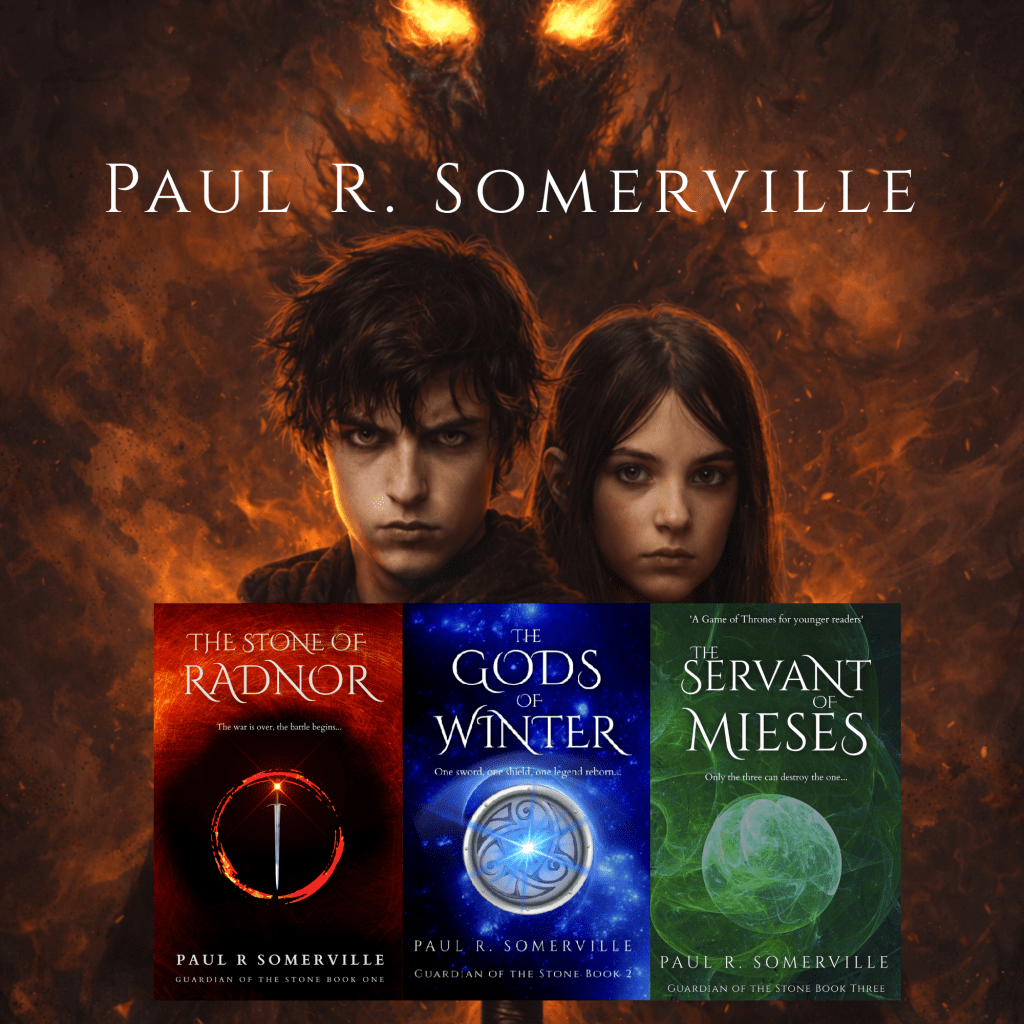
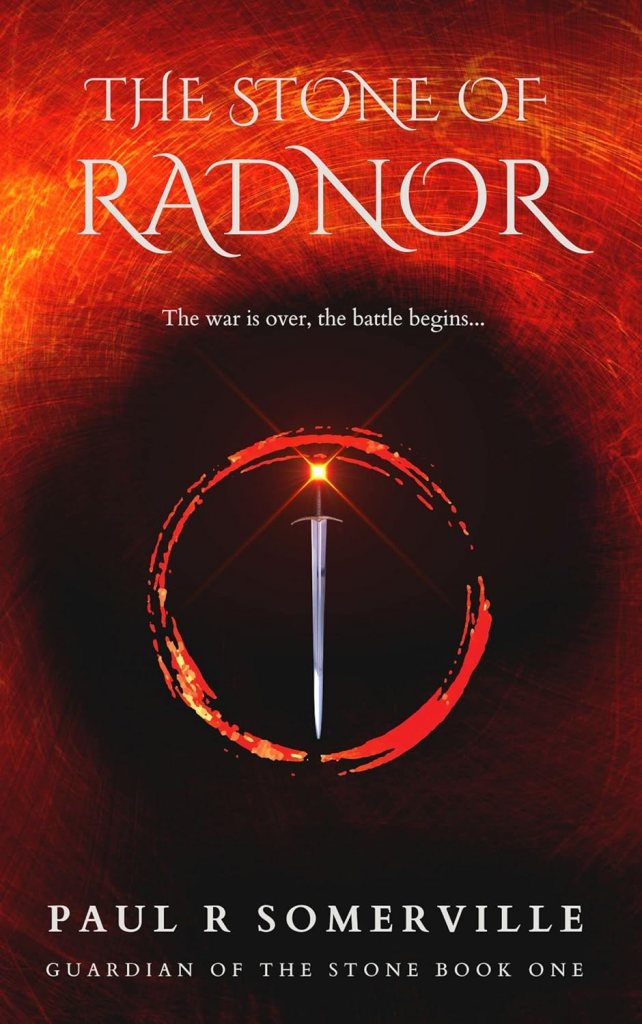
The cover of the Stone of Radnor represents Jaydon’s sword with the red god-stone on the pommel. I have been told it gives a LOTR feel, which wasn’t intentional but plays into the fantasy feel I wanted.
The Gods of Winter has a shield on the cover, which is representative of the Shield of Edora from the book, a magical shield that comes into Jaydon’s possession.
Finally, The Servant of Mieses, keeps the central ‘circular’ theme from the first two, but the colour representing Elokar’s god-stone, however the ethereal globe in the centre covers two things – the Stone of Mieses (a white globe) and the final climax of all the stones coming together (sorry no spoilers to explain more).
Personally I feel the covers represent the story well and do draw the eye.
Helen: The Guardians of the Stones trilogy is YA Fantasy. Is that the main genre you write?
Paul: I write fantasy – I read a lot of historical fiction, and what I enjoy is bringing real historical stories into my own world and fantasy-based settings. The world across the Guardian of the Stones series is called Calaria, and uses lots of real-historical references through research that I have done; for example, in the Gods of Winter, Jaydon needs to find the magical Shield of Edora to save a friends life – this idea sprung from historical myths around King Arthur and his search for the Cauldron of Anwr in what is now Anglesey.
I just love the idea of the creation of my elements from my own imagination – including those elements that bring more realism, aside from maps (which are in the books) I have created a language called Calar Ahunn (Old Calarian) – which is used sporadically through the books for prayers and magical components. The language is unique, but based on forms of Nordic, including a rune-based alphabet.
I have been heavily influenced by what I read – which includes both epic fantasy and historical fiction – with Bernard Cornwell’s Last Kingdom series of books being my main influence, the way he develops character and seeps you into his world I find completely inspiring.
In essence, writing fantasy allows my imagination to flow and run wild and re-use existing myths, legends and historical stories and create and morph them into my own world.
Helen: Isn’t it wonderful how the books we grew up become our inspiration as we go forward. I hope my books one day inspire others to write. With your books having such a historial influence, do you find you have to plan your books, or are you more of a pantser?
Paul: Oh – a complete pantser, which at times is amazing as I never know what direction my characters will take me in. But sometimes that’s to my detriment as, I have, on occasion, got myself in a pickle. A creative writing group covered this in an exercise and put this in an interesting term – you’re either a gardener or an architect. A gardener plants seeds, nurtures them and sees how they grow, never really knowing what they will grow to be like – if the fruits will actually appear. Whereas an architect works to a detailed plan that they have already sketched out.
Having said that, I do usually have an idea of how my stories end (sort of) and although not sure quite how I will get there, it gives me a point to aim for. In fact, as I get closer to the end – usually about two-thirds of the way through – I start to map out chapters, writing a paragraph on each, stating what I want it to cover, and asking myself any questions that I still need an answer to. One piece of advice I was given was to treat each chapter like a mini-story, with a beginning, middle and end – having an objective for each one.
I do need to plot a little more in my current WIP, I have realised the middle part of the book has become a little muddled and I’m not quite sure of the motivations of my side-characters, which has allowed my protagonist to become too passive. So, I am undertaking an exercise to plot out their goals and needs a little more.
Helen: That is some great advice. I thought you might have been more of a planner! You mentioned your WIP. Can you tell us what you are working on next?
Paul: I’m currently have two projects on the go – one a little more advanced than the other. The main project, The Emerald Passage, is a fantasy / sci-fi – using the premise of climate change as the catalyst for my protagonist become the centre of this change.
Earth has a sister planet called Galea, many light years away, which is linked by a secret portal. The portal’s existence is protected by a secret society of humans from both planets – however they follow a supreme entity called The Being, who is dying and the secret society need to save both worlds to protect The Being and save Earth and Galea in the process.
I based this premise on stories I researched on Thoth the Atlantean an Egyptian deity of wisdom, described in literature as an immortal Priest-King who survived the sinking of Atlantis, and mashed it with existing stories written by conspiracy theorists who claim that aliens live among us. I guess it’s become cross between a Dan Brown novel and Stargate.
My other WIP is called The Cursed Crown. This is still very much in the very early stages of development, but I’ve taken the premise of what happened when Emperor Nero died and the Roman Empire was thrown into civil war, with four emperors in a year. I am this premise into my own fantasy world – with the view point of my main character, who is a close friend to the man who ends up as the final emperor during this period of chaos. A long way to go, but one I am excited about.
Helen: You are very busy!! I wish you all the best with your books. Thank you so much for spending time with me today. Just to finish, what is the most useful piece of writing advice you’ve received, and from whom?
Paul: I’m certainly never short of being given advice!! 😊 I’ve been attending a creative writing group on and off for 6 years now. My tutor (Mel) is amazing and provides constant support and encouragement. The best advice she has given me is , write, write, write – even if it’s just a few words, just get it down. It doesn’t matter how good or bad it is, refining is the editing process.
I recently listened to Stephen King’s On Writing audio book. Although I don’t necessarily agree with everything that he said, he does say ‘Write the first draft with the door closed, the second with the door open.’ What he means by that is that the first draft you are writing for yourself, with the doors closed. Then you open the door and you are rewriting your story to the outside world, to your readers. I liked that analogy as I do tend to get myself bogged down trying to perfect a piece of prose or descriptive text on some scene, when actually I should just get the darn story written.
Being a self-published author, I’ve learned a lot through my own mistakes too. I certainly did with my first book – editing was a chore, and it’s costly paying someone to do this professionally, but that means that errors in grammar and typo’s creep in. It is definitely worth getting this done properly – and I’ve certainly had those errors pointed out to me after pressing the ‘publish’ button on KDP!!
Lots of people though have given me advice on what comes next, marketing, promoting etc. Every time I attend an event with other writers I learn more. One thing I have discovered is that the writing community, especially self-published and indie writers, are an amazing and helpful bunch of people, really supportive – I guess I now need to listen to that advice and become less of a luddite where social media and book promoting is concerned?

About the Author – Paul Somerville
Born in Burnley, Lancashire, Paul joined the British Army at the age of just 16 and served until 1999, having travelled widely (Norway, USA, Canada, Alaska, Germany, Belgium, Italy, Turkey, Portugal, Denmark, Croatia, Bosnia, Gibraltar) and completing three operational tours in the Former Yugoslavia during the Balkan conflict.
Since leaving the army Paul has worked in a variety of roles and organisations – but moved into Cyber Security, and is now a Principal Consultant for a UK based consultancy. Paul has lived in Malvern, Rugby, Farnham and now resides in Alton, Hampshire, with his two children, a mad-cat, two gerbils and several fish.
Outside of writing and work Paul is an avid supporter of Burnley FC and enjoys walking in the Hampshire and Surrey countryside and taking mini-adventures in his twenty-five year old campervan.
The Stone of Radnor is Paul’s debut novel.
Follow Paul on social:
Purchase The Stone of Radnor by Paul Somerville
UK: eBook | Paperback
USA: eBook | Paperback
As an Amazon Associate I may benefit from purchases made using these links.
If you enjoy epic fantasy then check out my award winning Sentinal series, which is now complete. If you like fantasy books with a touch of romance then you will love my SoulMist series, start with SoulBreather. Prefer Dystopian Science Fantasy? Then try Harmony. Start the adventure and stay for the journey.
Sign up to my newsletter and download a free novella called Sentinals Stirring and get notified when my next books are published.
By clicking the sign up button above, you agree to share your email address with the site owner and the newsletter platform provider to receive marketing, updates, and other emails from the site owner. Use the unsubscribe link in those emails to opt out at any time.
By signing up to my newsletter, you agree to receive commercial information from Helen Garraway, located at 61 Bridge St, Kingston, Hertfordshire, UK (Data Administrator). You can withdraw your consent at any time. The data will be processed until the consent is withdrawn.


