Thriller Author
It’s time to meet the author of the Stuart Finlay Universe, Jack Chandler. I’m excited to talk to her about her latest book which released tomorrow, November 21st, 2026.
Helen: Welcome, Jack. Thank you for joining me today. I am so excited to chat about your latest book in the Stuart Finlay universe. Tell us about Broken Bridges which launches tomorrow.
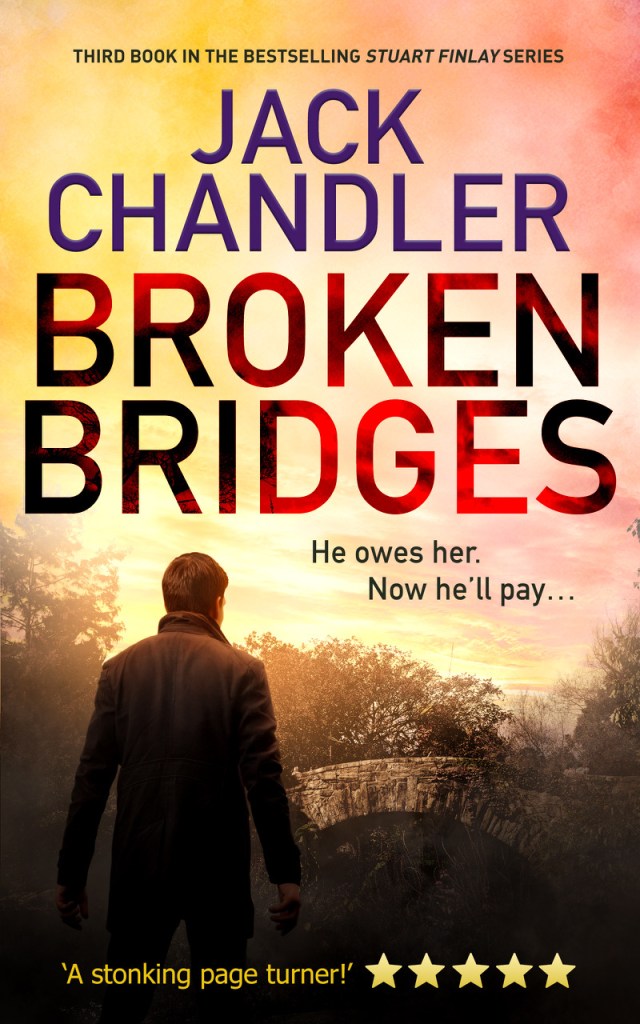
Jack: Broken Bridges, the third book in my private detective thriller series is due out on 21 November. It’s centred around Fin — someone who is very good at solving other people’s problems and considerably less successful at dealing with his own.Jack: Fin starts this book reeling from personal loss and trying his hardest not to engage with the world, when Janet Cahill contacts him. Her daughter, Olivia, disappeared eight years ago. Since then, there’s only been sporadic contact through brief text messages — until now. The messages have stopped. Her phone has gone dark, and Janet feels as though she’s losing her daughter all over again.
Jack: Janet was an important influence for Fin when he was a child, and he owes her more than he could ever repay, so saying no isn’t an option. But the deeper he digs into Olivia’s disappearance, the clearer it becomes someone wants the past to stay buried—and they’re prepared to make sure it does.
Readers can expect the same fast-paced, page-turning style as the earlier books, but with higher emotional stakes for Fin.
For anyone curious about the world before jumping in, there’s a free bonus story available on my website (jackchandlerbooks.com) set in the Stuart Finlay universe.
Helen: The curved bridge on the cover reminds me of a Roman bridge from my childhood. It was a place of magic and adventure. Why did you decide to have such a bridge on your cover?
Jack : Broken Bridges has two meanings – both a literal bridge that features in the story, and the bridges between Fin and his past. I wanted an old English country bridge on the cover, but also, I favour colourful covers. This book is a thriller. It’s not police procedural, it’s not cozy, it’s not gloomy. I wanted something that looked attractive to me and reflected the genre. What I write isn’t literature – it isn’t trying to be. It’s escapism. Pure, unadulterated, safe (for the reader ☺︎), adventure. Fun. So the covers are what I would call pretty. They’re colourful, but not gaudy. And that branding will continue throughout the series.
Helen: I always enjoy hearing the thoughts behind a cover. I imagine their are more Stuart Finlay books to come, are you working on the next one?
Jack: Singular? There’s never only one…
I’ve just finished editing book 3 in the Stuart Finlay series, Broken Bridges.
Without giving too much away, this story pushes Fin further than before emotionally as well as physically. He’s investigating a disappearance that reaches back years, and the more answers he uncovers, the more dangerous things become.
At the same time, the first draft to the fourth book in the series is already written, which has allowed me to plant little Easter eggs throughout the earlier books because I know what’s coming. Each book can be read as a standalone, but the series definitely benefits from being read in order.
While all that is going on, the audiobook for 13 Chances (the second book in the Stuart Finlay series) has just been released, courtesy of the wonderful people at RB Media. I’m listening to it now!
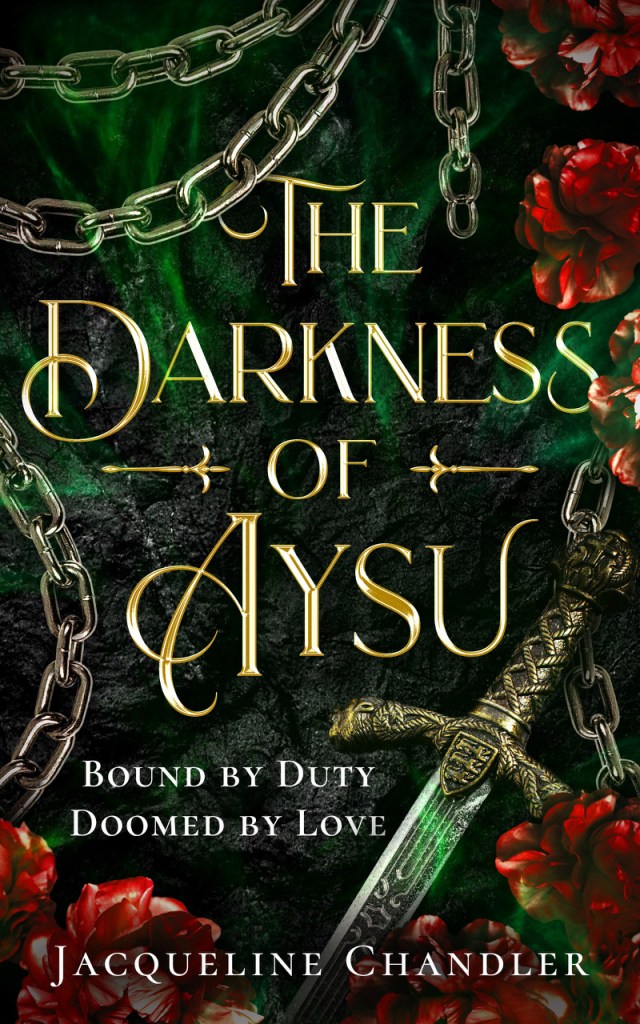
I’m starting to think about a sequel to my romantic-fantasy, The Darkness of Aysu.
And I have ideas for book 5 in the Stuart Finlay series, that’s stewing in the back of my brain. So you see, there’s never just one work in progress…
Helen: I’m the same. I always have multiple series noodling in the background. Have you ever thought of writing a book that is not a thriller?
Jack: I actually did this.
After writing two Stuart Finlay books, I needed a break from thrillers. I love writing them, but they’re emotionally exhausting. Fin’s world is dark, messy and dangerous, and as much as I adore my characters, I’ve discovered I’m not particularly kind to them.
So I thought I’d write something completely different. I ended up writing a romantic fantasy – which turned out to be just as emotionally heart-wrenching, only with more feelings and an ominous magical force.
The result was The Darkness of Aysu.
It follows Killian, a disillusioned castle guard trapped in service to a brutal ruler and desperate to escape with the only family he has left. Instead, he’s sent on a mission to escort Princess Shanree of Aysu through an arranged marriage to a tyrant. Except Shanree has no intention of becoming anyone’s obedient bride—and Aysu itself is hiding something ancient and dangerous.
What starts as duty becomes impossible choices, forbidden feelings, divided loyalties, and a growing Darkness that seems determined to break everyone involved.
I’m now solidly back in Fin’s world, but I’m tempted to write a sequel to Aysu, and I do have some ideas percolating in the back of my head so maybe I’ll revisit that genre again when I need my next mini holiday.
Helen: I think it is good to have a break from a series. It is easier to write when you come back refreshed. When did you realise you had a passion for writing?
Jack: I’ve always written in one form or another, but when I left school, I did the same aptitude test the rest of the class did, and the answer the thing spewed out was: librarian or accountant. To be fair, I think everyone got librarian! I’m a strange mix. I’m logical, but also creative. And I couldn’t fit into their 1980s algorithm, bless. Writing wasn’t considered to be a serious career choice. No one earned money off writing (unless you were Stephen King, which I’m not). You couldn’t go into a careers interview and say you wanted to be a writer.
But I hated working. I’m not saying everyone out there loves their job, but I had nothing invested in it. When I got pregnant, I worked out how much it would cost me to put the kids into daycare compared to what I earned (minus the days I’d have to take off whenever the kids were ill) and it just wasn’t worth it. I never earned that much. My husband, on the other hand, did. So we made some cuts so I could stay home allowing him to focus on his work and me to focus on the kids. It’s all very 1950s, but it suits us as a family. Then my kids got older…
I didn’t want to be one of those mothers who clung to their kids rather than let them fly free, so I needed something for me. I’d kept writing throughout my teens, through university, and through my child-rearing years. I couldn’t let it go. Now, as we were not financially dependent on me returning to work, I decided to make a serious go of it.
I joined Jericho Writers and attended their Festival of Writing. I came away with two uncomfortable but incredibly valuable realisations: first, I loved this more than I’d admitted to myself, and second, I’d been doing everything wrong.
I threw myself into online workshops, events, and writing education. I invested in a course, worked on finding my tribe, and getting into some sort of writing routine. I started entering competitions, and allowed myself to believe I could actually do this, and a career was born…
Helen: Congratulations on your journey. I came to writing late in life, and I have come to the realisation that I just love the whole creative process. I can’t imagine not writing now. The tribe around you is also tremendously important. What is the most valuable writing advice you have received?
Jack: When I wasn’t getting any interest from agents, loads of people suggested rewriting entirely or starting over. I couldn’t abandon Fin, though. I was considering self-publishing.
Sophie Flynn, managing director of Jericho writers, told me self-publishing isn’t a fallback position. You don’t do it because you can’t get an agent. You have to choose it.
That shifted my thinking completely.
It took 2-3 years after that conversation for me to commit to self-publishing. It wasn’t an easy decision, Sophie was absolutely right. Self-publishing is a lot of work, but here are some things people outside the industry don’t know: agents receive around 300 submissions a week. They aren’t paid to read these. This is something they have to do in their spare time when they’re not looking after the authors they already have. Of those 300 a week (let’s allow for some quiet months, and say that works out to be 12,000 a year,) they will take 1-3 authors that year. That is 0.02% of those submissions!
Agents are looking for something unique. Something unusual. Something they haven’t seen before and won’t see again. Those authors have to knock them off their feet. My books aren’t going to do that. My books are not intellectual. They don’t make people stop and consider their life choices. They allow them to escape for a few hours and have fun. That doesn’t mean the books won’t sell, it just means I won’t get an agent.
But choosing to self-publish is a life altering decision. You’re no longer ‘just’ the author. You’re the cover designer, the editor, the marketing department, publicity, media and communications, etc etc. You become a publishing company. This is an active choice not to be made lightly.
I made it. And I love it.
I’d never designed a website before. I’d never dealt with software much. And I was wholely uncomfortable with the idea of advertising or marketing. So I had a steep learning curve ahead of me, but on the upside, I sleep much better than I used to! ☺︎
The only things I outsource is cover design and editing. It’s really important to get those done professionally. And I am heavily involved in both.
Sophie Flynn was absolutely right with everything she said to me that day, and those words stayed with me. I have the career I’ve always wanted. I did it myself. For myself. With the wonderful support of my ever-understanding husband. Not having an obvious market hook doesn’t mean a book isn’t worth publishing. Write the best version of your story. Learn the business side. Give readers a chance to decide.
Helen: I agree with everything you said. I invest in editing and my cover design, so they can be the best they can be, everything else I do myself. Considering you do everything yourself, which are the tools that make your life easier?
Jack: Can’t… I can’t give you just one! It’s an impossible task!
My writing buddies! I have other authors I write ‘with’ (in an online call), who help me get my bum in the seat.
‘Jericho Writers’ taught me everything I know about the craft of writing and continue to be a prominent part of my writing life.
‘Learn Self-publishing’ taught me almost everything I know about self-publishing – David Gaughran taught me the rest.
For research, the police are incredibly approachable. I have spent hours in police stations (on the right side of the bars) asking questions and having wonderfully patient officers respond. Like I said, I don’t write police procedurals, but where they do feature, I want them to do so accurately, and for the rest of the novel, I want to know how far I can push the boundaries and still keep them out of it (ethically, if only semi-legally)!
As for software (and you can’t answer this question without considering software): Scrivener is where most of my drafting and editing happens. It is an incredible piece of software. Once the manuscript moves into professional edits, I have to switch to Word to accommodate my editor who is the wonderfully talented Debi Alper, who just gets me – it’s so important to have an editor who gets you.
For formatting, I use Atticus.
Outside of the manuscript itself, Excel deserves an honorary mention — I use it to track everything from timelines and release planning to ad performance and publishing admin. I have an impressive Gantt chart. It’s colour-coded. ☺︎
I also rely heavily on BookFunnel, my website, JackChandlerbooks.com, and the communities and courses I’ve invested in over the years. It’s all been a steep learning curve – I didn’t know how to use any of this stuff before I started, but it’s all required if you want a writing career. Writing the book is only part of the job.
Helen: The whole process is quite complex, and if not for these types of tools, it would be a lot more difficult! I too, have a very interesting excel workbook full of tabs and information on my Sentinal series. Every writer experiences self doubt at some point. How do you over come the fear and the doubting little voice in your head to keep writing?
Jack: Structure. Routine. Community.
There were definitely moments where I questioned whether I was good enough, whether anyone would read my books, and whether I was wasting my time. Hell, I still have those moments, and I’m sure I always will. In fact, if I ever sit back and think to myself, ‘oh yeah, I’ve got this’, then I’ve clearly not understood what this whole writing lark is about.
You don’t need permission to write today. Bang out a paragraph, if that’s all the time and energy you have for it today, but that’s still writing, it’s still worth it, and it’s still contributing to your project. As long as you put something on paper, you have something you can later come back and edit. If you don’t love it now, you will after you’ve edited it, but you can’t edit what isn’t there. So write anyway.
Helen: Great advice! I can tell you love writing. What is the best thing that has happened since you published your first book?
Jack: That little orange tag on Amazon when my first book, Ripped Into, hit the ‘Hot New Release’ slot. It then lost that orange tag and earned the ‘Bestseller’ little orange tag soon after.
The sequel, 13 Chances, got its little ‘Hot New Release’ orange tag two days before it was even released, thanks to pre-orders. And then it got its ‘Bestseller’ tag too.
That was just awesome. Let me explain why:
There are (at time of writing) between 32.8-50 million book titles on Amazon (their estimate). Now I didn’t hit the number one, number one, if you get what I mean. But my book hit the number one slot in its category in multiple countries. That is huge for a completely unknown debut author with no big publisher behind her. Everyone tells you your book will land with an insignificant thud onto the marketplace. I was expecting deafening silence. I would have known it was there, but the other 8 billion people in the world? Not so much. But some of them did, and I got those precious little orange tags.
I still can’t really believe that happened.
Now, every now and then, I get an email from someone who says they loved the book. I always respond personally, because that email is THE BEST part of my day. I’m not kidding. No reader has to contact an author. Frankly, we’re lucky if they bother to review the book at all (shockingly, only 1% of books read get reviewed), but to actually seek us out? Find our website and contact details, and send us an email? That’s special. That means so much, you’ve no idea.
Those are easily, my best things.
Helen: It has been lovely to chat to you about your books. I wish you all the best for your launch. Just to finish, what advice would you give to aspiring writers?
Jack: Treat writing like something worth taking seriously before anyone else does. Don’t let people pat you on the head and smile patronisingly when you tell them you’re an author. Speak proudly of what you do. When they ask, don’t ashamedly mumble, ‘yeah, I’m still writing that draft’. Be excited about it, spark their own curiosity by sharing yours.
Learn the craft. Learn the business. Find your people.
And don’t assume there’s only one route to publication. I chose to self-publish because I wanted control, speed, and the ability to test, learn, and improve rather than waiting months—or years—for decisions outside of my control. It’s not for everyone though – work out what sort of writer you are, what you want from this, and what resources you can commit to it.
Above all, treat this like a business. It is one. Your story is not your baby, it’s a product. It’s a wonderful, fantastic, exciting product, but it is a product. Not everyone will like it, not everyone will use it, but that’s OK, as long as you love it. So work on your product, get it out in the world, then start on the next one.
About the Author – Jack Chandler
Jack Chandler is a sleep-deprived parent, wife, author, and willing participant in an unbalanced cohabitation contract with a cat. She spends her time writing, playing strategic board games, doing puzzles, and turning the house and garden into a jungle. Check out her website for a free story in the series.
Her first thriller, Ripped Into, became a Hot New Release within five days of publication, and a Bestseller on Amazon within two weeks.
Follow Jack on social:
Buy Broken Bridges by Jack Chandler
As an Amazon Associate I may benefit from purchases made using these links.
If you enjoy epic fantasy then check out my award winning Sentinal series, which is now complete. If you like fantasy books with a touch of romance then you will love my SoulMist series, start with SoulBreather. Prefer Dystopian Science Fantasy? Then try Harmony. Start the adventure and stay for the journey.
Sign up to my newsletter and download a free novella called Sentinals Stirring and get notified when my next books are published.
By clicking the sign up button above, you agree to share your email address with the site owner and the newsletter platform provider to receive marketing, updates, and other emails from the site owner. Use the unsubscribe link in those emails to opt out at any time.
By signing up to my newsletter, you agree to receive commercial information from Helen Garraway, located at 61 Bridge St, Kingston, Hertfordshire, UK (Data Administrator). You can withdraw your consent at any time. The data will be processed until the consent is withdrawn.


